7 Inner Ear Balance Exercises You Can Do at Home
7 inner ear balance exercises for vestibular dizziness: gaze stabilization, habituation and balance training, with doses, safety tips and a 6-week plan.
EyeRehab - VOR Training Team
Published on November 13, 2026

Listen to this article
Natural Language Narration · 20 min
Quick answer
What exercises help inner ear balance problems?
Inner ear balance problems are treated with three types of exercise. Gaze stabilization, such as seated and standing VOR x1, keeps your vision steady when your head moves. Habituation repeats the head turns and bends that make you dizzy until they bother you less. Balance and gait training includes feet-together stance, tandem stance and walking with head turns. BPPV needs a repositioning maneuver instead.
Reviewed on November 13, 2026
Why Inner Ear Exercises Work
Your inner ear tells your brain how your head is moving. When one side is damaged, by an infection like vestibular neuritis for example, the two sides send mismatched signals. The result can be dizziness, unsteady walking, and vision that blurs or jumps when you turn your head. The 2022 clinical practice guideline on vestibular rehabilitation estimates that about one in three adults in the United States has some vestibular dysfunction, and that it becomes more common with age.
The good news is that the brain can learn to work around the problem, and the right practice helps it do that. A Cochrane review of 39 trials with 2,441 people found moderate to strong evidence that vestibular rehabilitation is a safe, effective treatment for one-sided inner ear problems, with no reported side effects. The seven inner ear balance exercises below cover the three types of exercise used in vestibular rehabilitation. They suit adults of any age, and you can do them at home with a chair, a counter and a hallway.
What exercises help inner ear balance problems?
Three types of exercise help inner ear balance problems: gaze stabilization to keep your vision steady when your head moves, habituation to calm dizziness that movement brings on, and balance and gait training to steady you when standing and walking. The 2022 guideline names all three, plus walking for endurance.
- Gaze stabilization (exercises 1 and 2): You keep your eyes on a target while you move your head. This trains the vestibulo-ocular reflex (VOR), which moves your eyes against your head movement so the world stays still. The guideline advises against using eye movements alone, without head movement, to train gaze stability. That is why both of these exercises move your head.
- Habituation (exercise 3): You repeat the movements that make you dizzy, a few at a time. The guideline describes it as repeated exposure to the movements that cause mild to moderate symptoms, which leads to fewer symptoms over time.
- Balance and gait training (exercises 4 to 6): Static balance means standing still on a smaller base. Dynamic balance means staying steady while you move, for example walking while you turn your head.
One common inner ear problem works differently. Benign paroxysmal positional vertigo (BPPV) happens when tiny crystals drift into the wrong canal of the inner ear. It is treated with a repositioning maneuver, such as the Epley maneuver, which a clinician usually performs. The Cochrane review found that repositioning maneuvers work better than exercise for BPPV in the short term. Exercise 7, Brandt-Daroff, is only for diagnosed BPPV and only if your clinician recommends it.
| Exercise | Type | Setup | Starting dose | Level |
|---|---|---|---|---|
| 1. Seated VOR x1 | Gaze stabilization | Seated, card at arm’s length | 30 to 60 seconds per direction, 3 times a day | Beginner |
| 2. Standing VOR x1 | Gaze stabilization | Standing at a counter, card on the wall | 30 to 60 seconds per direction, 3 times a day | Beginner to intermediate |
| 3. Head turns and bends | Habituation | Seated, then standing | Each movement 5 times, twice a day | Beginner to intermediate |
| 4. Feet-together stance | Static balance | Standing at a counter | Up to 30 seconds, 3 times | Beginner |
| 5. Semi-tandem and tandem stance | Static balance | Standing at a counter | Up to 30 seconds, 3 times per side | Intermediate |
| 6. Walking with head turns | Dynamic balance and gait | Clear hallway, near a wall | 2 to 3 lengths of the hallway | Intermediate to advanced |
| 7. Brandt-Daroff exercises | BPPV only | Sitting on the edge of a bed | 5 repetitions, 3 times a day, only if your clinician recommends it | Diagnosed BPPV only |
1. Seated VOR x1 (Gaze Stabilization)
If your vision blurs or bounces when you turn your head, or reading a sign while walking makes you dizzy, start here. Sitting down lets you train your eyes and head without worrying about your balance at the same time.
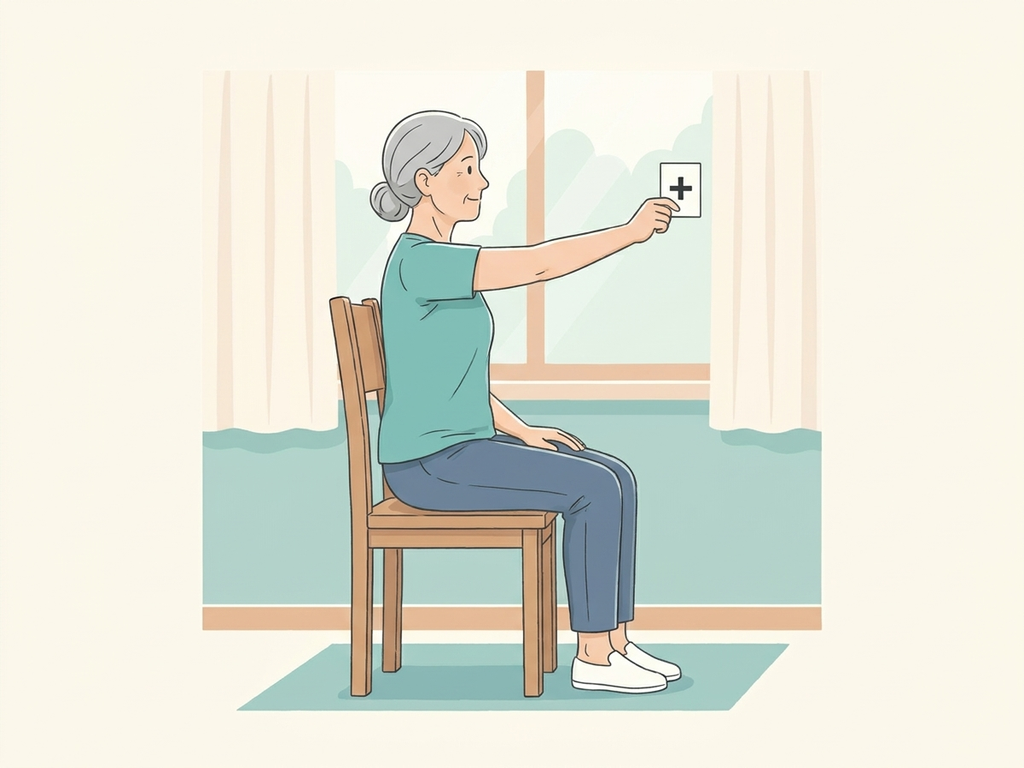
- Setup: Sit upright in a sturdy chair with your feet flat. Hold a card with a letter or symbol on it (a business card works) at arm’s length, straight in front of your nose at eye level. Good light helps.
- Steps:
- Look at the letter and keep it in focus.
- Turn your head a small distance left and right, as if saying “no,” while the card stays still.
- Move only as fast as you can while the letter stays clear. Keep going for 30 to 60 seconds.
- Rest until any dizziness settles.
- Repeat with small up-and-down “yes” movements for 30 to 60 seconds.
- Do this set 3 times a day.
- Progression: Build up to 1 to 2 minutes in each direction. Turn your head a little faster while keeping the letter clear. When the seated version feels easy, move on to exercise 2.
- Common Mistakes & Tips: Move your head, not the card. If the letter blurs, you are going too fast. Keep the movement small and your shoulders relaxed. If your neck hurts, make the turns smaller and ask your clinician.
2. Standing VOR x1 (Gaze Stabilization)
The same exercise done standing adds a balance challenge, which is closer to daily life. Putting the target on the wall frees your hands to rest on the counter.
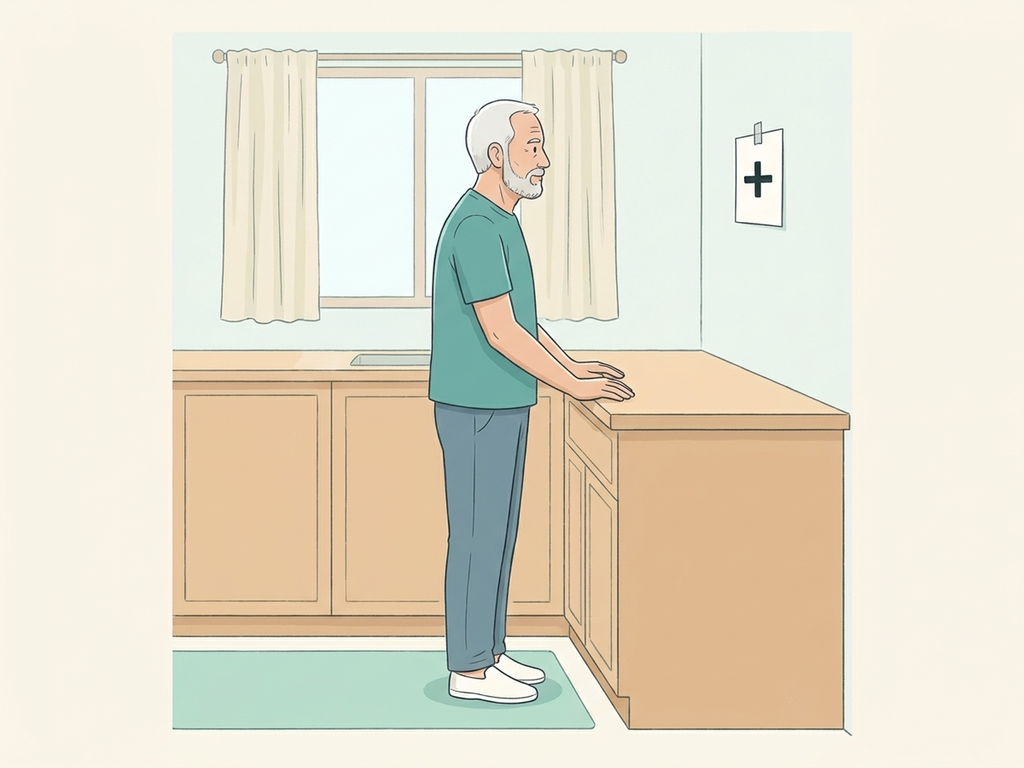
- Setup: Tape a card with a letter or symbol to a wall at the height of your eyes. Stand at your kitchen counter facing the card, with your feet hip-width apart and both hands resting lightly on the counter.
- Steps:
- Look at the letter on the card.
- Turn your head left and right while keeping the letter in focus, for 30 to 60 seconds.
- Rest until any dizziness settles.
- Repeat with up-and-down movements for 30 to 60 seconds.
- Do this set 3 times a day. Once standing is comfortable, it can replace the seated version.
- Progression: Bring your feet closer together. Then rest one hand on the counter, then keep both hands hovering just above it. Later, stand at different distances from the card, or put it on a busy, patterned background.
- Common Mistakes & Tips: Don’t lock your knees or hold your breath. If you start to sway, rest your hands back on the counter and slow down.
3. Head Turns and Bends (Habituation)
Habituation means practicing the movements that make you dizzy, in small, controlled doses, until your brain stops reacting so strongly to them. The classic version is the Cawthorne-Cooksey exercises, developed in the 1940s. They include head movements, bending over and standing up, practiced first lying down, then sitting, then standing.
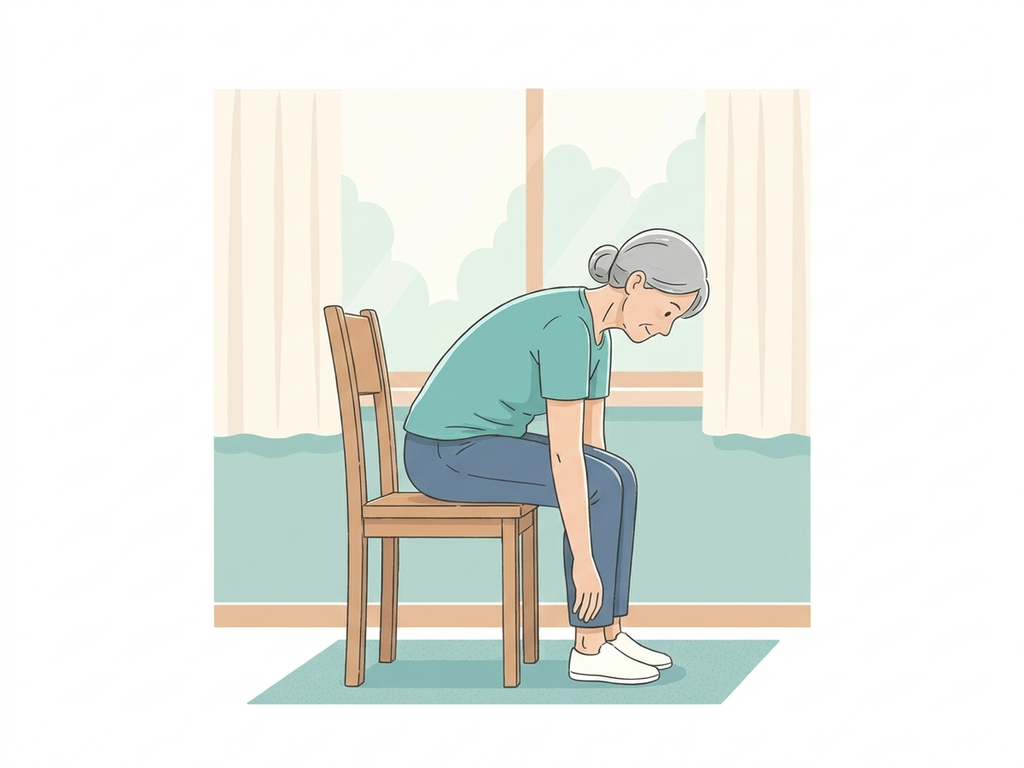
- Setup: Sit in a sturdy chair with your feet flat on the floor. Think about which movements bring on your dizziness, such as turning your head quickly, looking up or bending down. Pick two or three that cause mild to moderate symptoms, not severe ones.
- Steps:
- Head turns: Turn your head to look over your left shoulder, then over your right shoulder, at a steady pace. Do 5 turns each way.
- Up and down: Look up toward the ceiling, then down at the floor. Do 5 of each.
- Forward bends: Slowly bend forward as if reaching for your shoes, then sit back up tall. Do 5.
- After each movement, wait for any symptoms to settle before you start the next one.
- Do the routine twice a day.
- Progression: When a movement no longer makes you dizzy, do it a little faster. Then do the head turns standing at a counter, and later while walking (exercise 6). Do the forward bends standing only once seated bends cause no symptoms, and keep a hand on the counter.
- Common Mistakes & Tips: A mild rise in dizziness is how this exercise works, so don’t stop at the first flicker. Severe symptoms mean the movement is too hard for now, so choose an easier one. If you get lightheaded when you stand up, sit up slowly from the bends.
4. Feet-Together Stance (Static Balance)
When your inner ear sends weaker signals, your brain leans more on your eyes and feet. Standing with your feet together shrinks your base of support, so your whole balance system has to work.
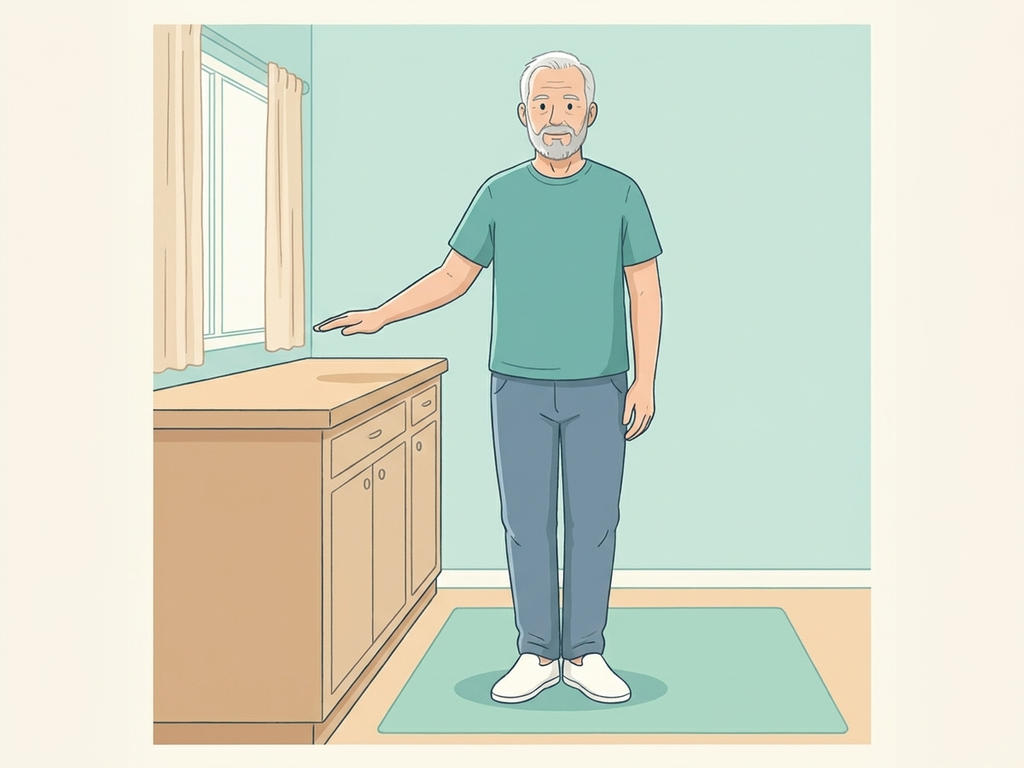
- Setup: Stand beside your kitchen counter, or in a corner of a room, so support is within reach. Wear supportive shoes.
- Steps:
- Start with your feet hip-width apart, one hand resting on the counter.
- Bring your feet together so they touch.
- Lift your hand so it hovers just above the counter.
- Look at a fixed point straight ahead and hold for up to 30 seconds.
- Rest, then repeat 3 times.
- Progression: Cross your arms over your chest. Then add slow head turns while you hold the stance. Standing on a cushion or closing your eyes makes it much harder. Try those only if your clinician says they suit you, and with someone beside you.
- Common Mistakes & Tips: A little sway is normal and is part of the training. Touch the counter if you need to, then try again. Keep your knees soft rather than locked.
5. Semi-Tandem and Tandem Stance (Static Balance)
Placing one foot in front of the other narrows your base from side to side, which is harder than feet together. It also prepares you for turning and stepping around things at home.
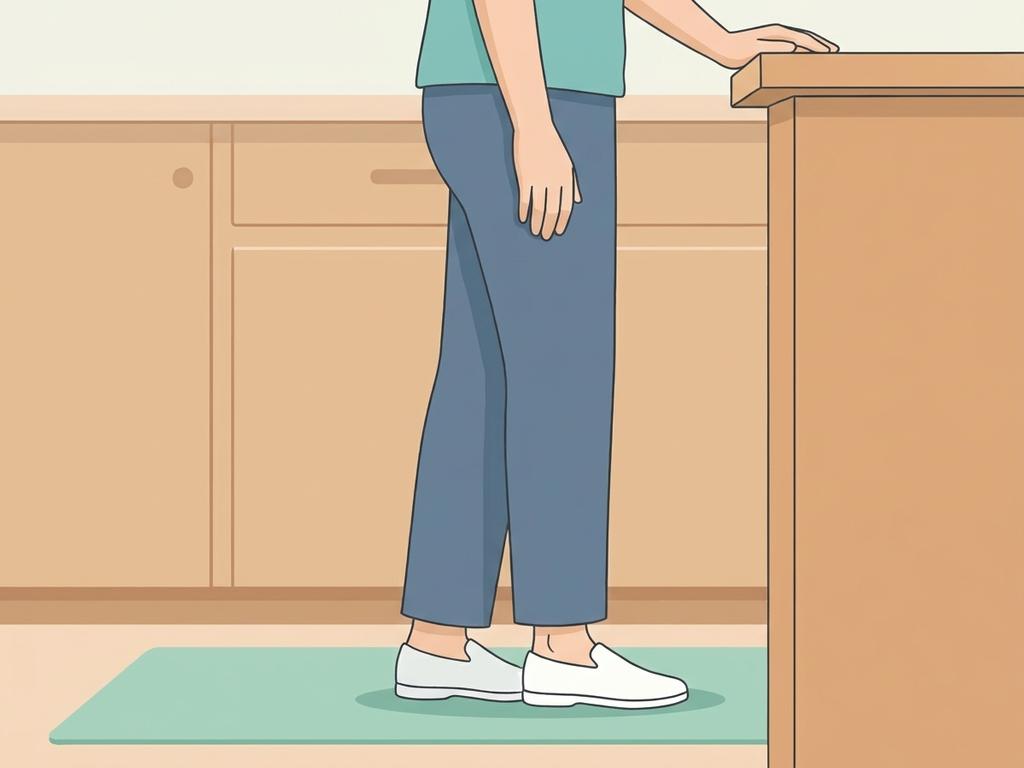
- Setup: Stand at your kitchen counter with one or both hands resting lightly on its edge.
- Steps:
- Semi-tandem: Place one foot half a step ahead, so its heel sits beside the big toe of the other foot.
- Hold for up to 30 seconds, looking straight ahead. Do 3 holds, then switch which foot is in front.
- Tandem: When semi-tandem feels steady for 30 seconds, place one foot directly in front of the other, heel touching toes, as if standing on a line.
- Hold for up to 30 seconds. Do 3 holds with each foot in front.
- Progression: Go from two hands to one hand, then to fingertips, then to hands hovering just above the counter. Later, add slow head turns. Eyes-closed tandem stance is an advanced exercise. Try it only with your clinician’s okay and someone right beside you.
- Common Mistakes & Tips: Don’t look down at your feet. Look at a point at eye level instead. Breathe normally.
6. Walking With Head Turns (Dynamic Balance and Gait)
Walking while you turn your head combines gaze, habituation and balance training in one task, and it copies what you do every day: crossing a street, looking for someone in a store, glancing at a shelf.
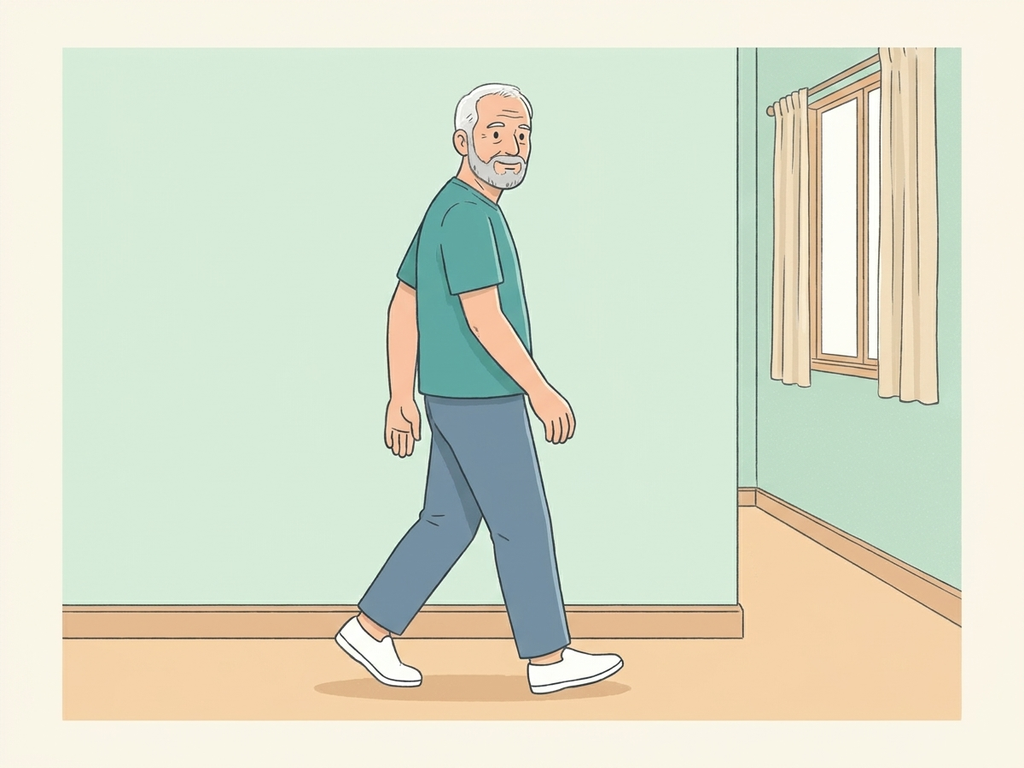
- Setup: Use a clear hallway with good light and a wall within reach. Remove loose rugs and clutter. If you feel unsteady, have someone walk beside you on your open side.
- Steps:
- Walk the length of the hallway at your normal pace, looking straight ahead.
- Walk it again, turning your head to look left for two steps, back to center, then right for two steps. Keep walking in a straight line.
- Stop and rest at the end of the hallway until any dizziness settles.
- Do 2 to 3 lengths.
- Progression: Add up-and-down head movements. Turn your head a little faster. Tape a few cards along the wall and read each one as you pass. Practice outside or in a quiet store only when hallway walking feels steady, and bring a companion at first.
- Common Mistakes & Tips: Many people slow down or stop each time they turn their head. Try to keep a steady pace. If you drift sideways, slow the head turns down and stay close to the wall.
7. Brandt-Daroff Exercises (Only for Diagnosed BPPV)
Brandt-Daroff exercises are for BPPV only, and only if a clinician recommends them. BPPV causes short spells of spinning when you lie down, roll over in bed, look up or bend down. The BPPV guideline strongly recommends treating the most common form with a repositioning maneuver. It also lists vestibular rehabilitation, done on your own or with a clinician, as an option. Brandt-Daroff is one of the home exercises a clinician may suggest alongside or instead of a maneuver. Read more in our guide to how BPPV treatment works.
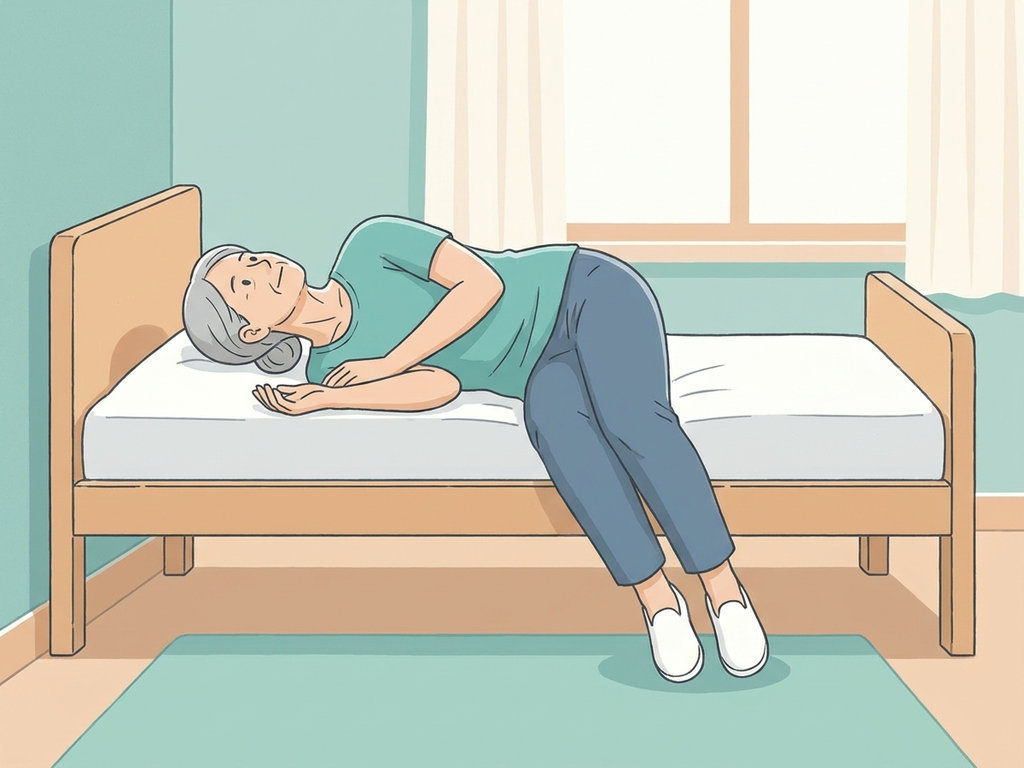
- Setup: Sit upright in the middle of the edge of your bed. Have someone nearby, since the exercise is meant to bring on brief spinning. Ask your clinician first if you have neck or back problems.
- Steps:
- Turn your head 45 degrees to the left, about halfway to your shoulder.
- Keeping your head turned, lie down on your right side. Your nose should point up at an angle, not straight at the ceiling.
- Stay there for 30 seconds, or until any dizziness settles.
- Sit up, turn your head back to the center and stay sitting for 30 seconds.
- Turn your head 45 degrees to the right and lie down on your left side. Stay for 30 seconds, or until any dizziness settles.
- Sit up and turn your head back to the center. That is one repetition.
- Do 5 repetitions per session, 3 sessions a day (morning, afternoon and evening), for 2 weeks, or as your clinician advises.
- Progression: There is no progression to work toward. If the spinning has not improved after 2 weeks, go back to your clinician. You may need a repositioning maneuver, or a check for a different problem.
- Common Mistakes & Tips: Don’t try this before BPPV has been diagnosed. The positions can also provoke other kinds of dizziness. Spinning and mild nausea during the exercise are expected and should wear off after you finish. Stop if you feel neck or back pain or feel faint. Sit for a while before you stand up and walk.
Do you need a diagnosis before doing inner ear exercises?
It is wise to get one, because different inner ear problems need different treatment. Exercises 1 to 6 are designed for a weak or damaged balance organ, called vestibular hypofunction, for example after vestibular neuritis. The 2022 guideline’s advice applies to that kind of inner ear problem. It notes that it may not apply to dizziness that comes from the brain rather than the inner ear.
Get these checked by a doctor first:
- BPPV: Short spells of spinning, usually lasting under a minute, set off by lying down, rolling over or looking up. A repositioning maneuver usually treats it faster than any exercise.
- Ménière’s disease: Attacks of vertigo lasting minutes to hours, with fluctuating hearing, ringing or fullness in one ear. It needs medical care. Don’t exercise during an attack. See our safe plan for Ménière’s disease.
- Vestibular migraine: Episodes of dizziness, with or without headache, often with sensitivity to light, sound or motion. Migraine care comes first or alongside, and exercises usually start gentler. See vestibular migraine exercises and triggers.
- Sudden hearing loss: This one is urgent. The U.S. National Institute on Deafness and Other Communication Disorders calls sudden deafness a medical emergency and advises seeing a doctor immediately. It notes that treatment delayed more than two to four weeks is less likely to help.
Once you have a diagnosis, the guideline also recommends that clinicians offer supervised vestibular rehabilitation. A vestibular physical therapist can choose your starting level, check your technique and adjust the plan. Our comparison of vestibular rehab at home vs physical therapy can help you decide what mix suits you.
How often should you do inner ear balance exercises?
Most people do gaze stabilization exercises at least 3 times a day and balance exercises every day, for at least 4 to 6 weeks. In the 2022 guideline, clinicians may prescribe weekly clinic visits plus a home program of gaze stabilization exercises:
- In the early weeks after an inner ear injury: at least 3 times a day, adding up to at least 12 minutes a day.
- For a long-standing one-sided problem: 3 to 5 times a day, adding up to at least 20 minutes a day, for 4 to 6 weeks.
- For balance exercises with a long-standing problem: at least 20 minutes a day for at least 4 to 6 weeks.
The guideline rates the evidence for the gaze doses as moderate to weak and for the balance dose as moderate, so treat them as a starting point that your clinician can adjust. People with damage on both sides usually need longer programs.
Here is a sample 6-week plan built on that advice:
| Weeks | What to do | How often |
|---|---|---|
| 1–2 | Seated VOR x1 in both directions; seated head turns and bends; feet-together stance with hands hovering | VOR 3 times a day; habituation twice a day; balance once a day |
| 3–4 | Standing VOR x1; semi-tandem stance; head turns standing at the counter | VOR 3 to 5 times a day; habituation twice a day; balance daily, working toward 20 minutes in total |
| 5–6 | VOR x1 sets of 1 to 2 minutes; tandem stance; walking with head turns in the hallway | VOR 3 to 5 times a day; balance and walking daily |
Brandt-Daroff is not part of this plan. It is a separate 2-week course for BPPV, used only when a clinician recommends it.
When can you stop? The guideline lists reaching your goals, symptoms going away, balance returning to normal, or a plateau in progress as reasons to end therapy. Many people keep a short version going, along with daily walking.
How do you do inner ear exercises safely?
- Expect mild symptoms: Dizziness, mild nausea or a “full head” feeling often rise a little during the exercises. They should settle soon after you stop. If symptoms are strong, last into the evening or are worse the next morning, do less next time.
- Rate your symptoms: Score your dizziness from 0 to 10 before and after each session. Over the weeks, the same exercise should bring a smaller rise.
- Keep support within reach: Use a counter, a corner or a helper for every standing exercise. Clear the floor of rugs and cords, and wear supportive shoes.
- Save the hard versions for later: Do eyes-closed or cushion exercises only with your clinician’s okay and someone beside you.
- Skip sessions during attacks: Don’t exercise during a Ménière’s attack, a migraine attack or a new bout of severe vertigo.
- Get rechecked: Go back to your doctor or therapist if you are not improving after a few weeks, if you fall, or if your symptoms change.
Some symptoms need urgent care rather than exercise. Sudden hearing loss in one ear is a medical emergency, so see a doctor right away. Dizziness that comes on suddenly with double vision, slurred speech, a drooping face, or trouble walking can be a sign of stroke.
Call emergency services if you have chest pain, fainting, a sudden severe headache, trouble speaking, weakness or numbness on one side of the body, sudden double vision or loss of vision, or sudden severe vertigo with inability to stand or walk.
Key Takeaways
- Three types of exercise: Gaze stabilization, habituation, and balance and gait training each target a different part of the problem.
- Move your head, not just your eyes: Gaze stabilization works by keeping your eyes on a target while your head moves.
- Mild symptoms are part of it: Aim for a small rise in dizziness that settles soon after you stop, never severe symptoms.
- BPPV is different: It is treated with a repositioning maneuver. Do Brandt-Daroff only for diagnosed BPPV and only if your clinician recommends it.
- Little and often, for weeks: Gaze exercises at least 3 times a day and balance work daily, for at least 4 to 6 weeks.
Build Your Routine with EyeRehab
The EyeRehab - VOR Training app guides you through VOR x1 and VOR x2, Cawthorne-Cooksey, Brandt-Daroff, optokinetic and static balance exercises. It tracks dizziness, brain fog, headache, eye strain and nausea on a 0 to 10 scale before and after each session, so you can see whether the same exercise bothers you less over time. It also adjusts the difficulty as you improve. The app is free for patients.
Would you rather work with someone in person? Find a vestibular clinician near you. Physical therapists can use EyeRehab with their patients to assign home exercise programs and follow progress between visits.
Medical Disclaimer
This content is for informational and educational purposes only and does not constitute medical advice, diagnosis or treatment. Dizziness has many causes, and some need urgent care. Talk to your doctor or a vestibular physical therapist before starting these exercises, especially if your dizziness is new, you have had a fall, or you have neck, back, heart or blood pressure problems. If you have sudden hearing loss, severe dizziness with other neurological symptoms, or a sudden loss of balance, seek medical attention immediately.
Related reading
Frequently Asked Questions
What exercises help inner ear balance problems?
Vestibular rehabilitation uses three types of exercise. Gaze stabilization, such as VOR x1 with a small card, keeps your vision steady when your head moves. Habituation repeats the head turns and bends that trigger your dizziness, in small doses, until they bother you less. Balance and gait training, such as feet-together stance, tandem stance and walking with head turns, steadies you on your feet. BPPV is the exception: it is treated with a repositioning maneuver.
Do you need a diagnosis before doing inner ear exercises?
It is wise to get one. These exercises are meant for a weak or damaged balance organ, for example after vestibular neuritis. BPPV is treated with a repositioning maneuver, Ménière's disease and vestibular migraine need their own medical care, and sudden hearing loss is a medical emergency. A doctor or vestibular physical therapist can tell you which problem you have and which exercises suit it.
How often should you do inner ear balance exercises?
The 2022 vestibular rehabilitation guideline suggests gaze stabilization exercises at least 3 times a day. That adds up to at least 12 minutes a day in the early weeks after an inner ear injury, and at least 20 minutes a day for 4 to 6 weeks for a long-standing problem. For long-standing problems it also suggests balance exercises for at least 20 minutes a day for 4 to 6 weeks.
Is it normal to feel dizzier when I start these exercises?
Yes. A mild rise in dizziness is expected, especially with head movement and habituation exercises, and it should settle soon after you stop. Aim for mild to moderate symptoms, never severe ones. If your symptoms are strong, last into the evening or leave you worse the next day, do fewer repetitions or move more slowly, and tell your clinician.
Tags
Written by
EyeRehab - VOR Training Team
Expert insights on vestibular rehabilitation and eye health.
Related Articles

What Happens to Your Eyes During BPPV? Nystagmus Explained
During BPPV, your eyes jerk in a pattern called nystagmus. See what it looks like, how the Dix-Hallpike test reads it and why it decides your maneuver.
EyeRehab - VOR Training Team
November 20, 2026

How to Record Nystagmus With Your Phone for Your Doctor
How to film nystagmus on your phone so your doctor can see it: safety first, light, distance, a step-by-step checklist, and what a 2026 UCL study found.
EyeRehab - VOR Training Team
November 20, 2026

Is Nystagmus Dangerous? Warning Signs and When to Get Help
Nystagmus itself isn't dangerous, but its cause can be. Learn the stroke warning signs, what the HINTS exam is, and when to see a doctor or go to the ER.
EyeRehab - VOR Training Team
November 20, 2026