Meniere Disease Balance Exercises: Safe Plan
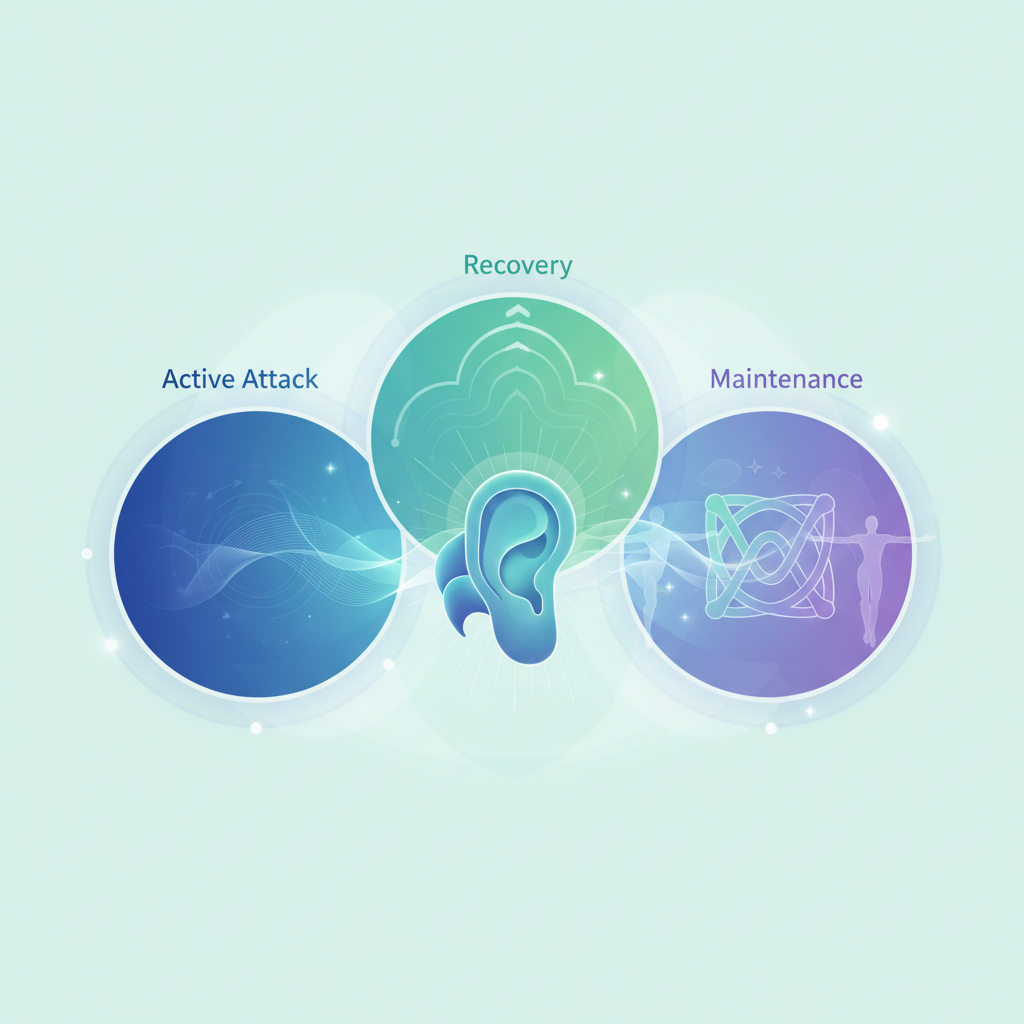
A safe balance-exercise plan for Meniere disease that separates active attacks from recovery and maintenance work.
EyeRehab - VOR Training Team
Published on June 5, 2026
Listen to this article
Natural Language Narration · 9 min
Quick answer
Can exercises help Meniere disease?
A safe balance-exercise plan for Meniere disease that separates active attacks from recovery and maintenance work.
Reviewed on June 5, 2026
Finding Balance: A Guide to Managing Meniere’s Disease
Living with Meniere’s disease means navigating unpredictable episodes of vertigo, hearing fluctuations, and balance challenges. While there is no cure for the underlying condition, incorporating targeted Meniere’s disease exercises into your daily routine can help your brain compensate for vestibular dysfunction and improve your overall stability. This guide provides a safe, evidence-based plan to help you manage symptoms and regain confidence in your balance.
Can exercises help Meniere disease?
Yes, exercises can significantly help individuals with Meniere’s disease. While physical therapy cannot stop the underlying fluid buildup in the inner ear, vestibular rehabilitation exercises are highly effective at training the brain to rely on alternative sensory inputs—like vision and proprioception (body awareness)—to maintain balance. This process is known as neuroplasticity, or central compensation.
By practicing specific movements consistently, patients can reduce their subjective dizziness, decrease the frequency of imbalance episodes, and improve their functional mobility. Healthcare professionals frequently prescribe vestibular rehab for Meniere’s to help patients safely return to their daily activities and reduce the risk of falls.
Understanding Vestibular Rehab for Meniere’s
Vestibular rehabilitation focuses on three primary areas: gaze stabilization, habituation, and balance training.
- Gaze Stabilization (VOR Training): The vestibulo-ocular reflex (VOR) keeps your vision stable when your head moves. Damage from Meniere’s disease can disrupt this reflex, causing visual blurring or a bouncing visual field. Exercises like VOR x1 and VOR x2 retrain the connection between your eyes and inner ear.
- Habituation: This involves repeated, controlled exposure to movements or visual environments that trigger dizziness. Over time, the brain learns to tolerate these triggers without producing severe vertigo symptoms.
- Balance Training: By practicing static and dynamic balance exercises, you strengthen your core and improve your body’s ability to keep you upright even when your inner ear sends faulty signals.
What should be avoided during active vertigo?
During an acute Meniere’s vertigo attack, you should avoid intense visual stimulation, rapid head movements, and any physical exercises that challenge your balance.
When you are experiencing active spinning vertigo, severe nausea, or sudden hearing drops, your inner ear is sending highly inaccurate signals to your brain. Attempting to “push through” intense vestibular exercises or doing complex Meniere’s balance exercises during an attack can overwhelm your nervous system, exacerbate your symptoms, and delay your recovery.
During an active flare-up:
- Rest in a safe, comfortable position (often lying down or sitting in a supported chair).
- Avoid bright screens, busy visual environments (like grocery store aisles), and rapid scrolling.
- Keep your head still to minimize nausea.
- Focus on Meniere’s vertigo relief through prescribed medications or resting strategies provided by your doctor.
Safe Meniere’s Disease Exercises to Perform Between Attacks
The most effective time to perform vestibular exercises is during your stable periods—the times between attacks when your symptoms are at their baseline. The following exercises are generally safer to perform when you are not experiencing acute vertigo. Always perform these in a safe environment, standing near a wall, in a corner, or using a sturdy chair for support.
1. Gaze Stabilization (VOR X1)
This exercise helps retrain your eyes to stay focused even when your inner ear is functioning poorly.
- How to do it: Sit in a chair. Hold a target (like a pen or a playing card) at eye level, about 12 inches from your face. Keep your eyes focused strictly on the target. Slowly turn your head to the left and then to the right, as if shaking your head “no.”
- Goal: The target should remain completely clear and in focus. If it blurs or bounces, slow your head movement down.
- Progression: Once easy while sitting, try performing this while standing, and eventually try it while walking.
2. Static Balance Training
Static balance exercises help improve your stability when you are standing still.
- Romberg Stance: Stand with your feet close together, touching. Hold this position for 30 seconds. If this is easy, try closing your eyes (ensure you are in a corner or have a spotter).
- Semi-Tandem Stance: Place the instep of one foot touching the big toe of your other foot (slightly staggered). Hold for 30 seconds, then switch feet.
- Tandem Stance: Place one foot directly in front of the other, heel touching toe (like walking a tightrope). Hold for 30 seconds.
3. Visual Tracking (Smooth Pursuits)
This exercise trains your eyes to track moving objects without triggering dizziness.
- How to do it: Hold a target at arm’s length. Keep your head completely still. Slowly move the target from left to right, then up and down, following it smoothly with your eyes only.
4. Cawthorne-Cooksey Exercises
These are a classic set of habituation exercises that involve moving the head and eyes in coordinated patterns. They can include moving the eyes side to side, focusing on a moving finger, and transitioning from sitting to standing. These movements help the brain gradually get used to motions that normally provoke dizziness.
Creating a Safe Plan for Meniere’s Disease Exercises
A successful exercise plan for living with Meniere’s disease requires careful pacing, symptom tracking, and gradual progression. Pushing too hard can trigger a setback, while doing too little will not provide the brain with the stimulus it needs to adapt.
1. Track Your Symptoms Daily
Before and after you exercise, track your symptoms. Monitor metrics like dizziness, headache, brain fog, eye strain, and nausea on a scale of 1-10. If your symptoms spike significantly and do not settle down within 20 to 30 minutes after finishing your exercises, you have pushed too hard and need to reduce the intensity or duration for your next session.
2. Start Small and Progress Slowly
Begin with exercises performed while sitting. Once you can complete them without a spike in symptoms, progress to standing. From standing, you can eventually progress to walking or performing dynamic balance tasks.
3. Know When to Seek Care
Vestibular rehabilitation should challenge you, but it should not be punishing. If you experience a sudden, severe change in your hearing, unrelenting vertigo that does not subside, or if you fall, stop your exercises and consult your healthcare provider or physical therapist immediately.
Key Takeaways
- Exercises are highly effective for Meniere’s disease. While they do not cure the inner ear condition, they train the brain to compensate for faulty balance signals, improving long-term stability.
- Do not exercise during active vertigo. Rest during acute attacks. Focus on exercises only during your stable periods between flare-ups.
- Focus on gaze stabilization and balance. VOR training, static balance, and visual tracking are the safest and most effective exercises to perform between episodes.
- Always prioritize safety. Use support, track your symptoms meticulously, and progress slowly to avoid triggering severe dizziness.
Start Your Recovery with EyeRehab - VOR Training
Building a safe vestibular exercise routine is much easier with guided, structured support. The EyeRehab - VOR Training app is designed specifically for vestibular recovery, offering built-in VOR x1, VOR x2, smooth pursuit, and static balance protocols. With features for daily symptom tracking and automatic difficulty progression, you can safely manage your Meniere’s balance exercises at home, knowing you are following clinical-grade parameters. Download EyeRehab today to take control of your vestibular health.
Medical Disclaimer
This content is for informational and educational purposes only. It is not a substitute for professional medical advice, diagnosis, or treatment. Always seek the advice of your physician, physical therapist, or other qualified health provider with any questions you may have regarding a medical condition or before starting a new exercise program.
Frequently Asked Questions
Can exercises help Meniere disease?
Use symptom patterns, safety, and day-to-day function to decide the next step. Seek urgent care for danger signs, and ask a qualified clinician for guidance when symptoms are worsening, unsafe, unusual, or not improving.
Which balance exercises are safer between attacks?
Use symptom patterns, safety, and day-to-day function to decide the next step. Seek urgent care for danger signs, and ask a qualified clinician for guidance when symptoms are worsening, unsafe, unusual, or not improving.
What should be avoided during active vertigo?
Use symptom patterns, safety, and day-to-day function to decide the next step. Seek urgent care for danger signs, and ask a qualified clinician for guidance when symptoms are worsening, unsafe, unusual, or not improving.
Tags
Written by
EyeRehab - VOR Training Team
Expert insights on vestibular rehabilitation and eye health.
Related Articles
PPPD (Persistent Postural-Perceptual Dizziness): Symptoms, Triggers, and Rehab
What PPPD is, why chronic dizziness lingers after the trigger has healed, and how graded vestibular rehab helps you get steady again.
EyeRehab - VOR Training Team
July 1, 2026
Walking Balance Exercises After Concussion
A post-concussion walking balance guide that links gait, head movement, visual load, and safe progression.
EyeRehab - VOR Training Team
June 25, 2026

Balance Exercises With Eyes Closed: Safety and Progression
Explain how eyes-closed balance exercises change sensory demand and how to progress them safely.
EyeRehab - VOR Training Team
June 20, 2026