6 Gaze Stabilization Exercises for Older Adults With Dizziness
6 gaze stabilization exercises for older adults with dizziness: VOR x1, VOR x2 and remembered-target head turns, with doses, progression and safety tips.
EyeRehab - VOR Training Team
Published on November 13, 2026
Listen to this article
Natural Language Narration · 18 min
Quick answer
What gaze stabilization exercises help older adults with dizziness?
The main gaze stabilization exercises for older adults are VOR x1 head turns, side to side and up and down, while the eyes stay on a still target: first seated, then standing at a counter, then against a busy background. VOR x2 and remembered-target head turns come later. Guidelines suggest at least three short sessions a day.
Reviewed on November 13, 2026
Why Gaze Stabilization Matters as You Get Older
Your inner ear does more than hear. Its balance organs tell your eyes how your head is moving, so your eyes can move the opposite way and keep the world still. This is the vestibulo-ocular reflex, or VOR. When that balance signal is weak, after an inner ear infection such as vestibular neuritis or with age-related decline, your vision can blur or seem to “bounce” when you turn your head or walk. Many people also feel dizzy and unsteady. A 2022 U.S. clinical practice guideline estimates that about one in three U.S. adults has some vestibular dysfunction, and that it becomes more common with age. It also notes that older adults with vestibular and balance disorders have a 5 to 8 times higher risk of falling than healthy people their age.
The same guideline has good news. Age does not limit how much you can improve with vestibular therapy, and clinicians should offer it to older adults “with the expectation of good outcomes.” Gaze stabilization exercises for older adults are at the heart of that therapy. In a small trial of 39 older adults with dizziness whose inner-ear tests were normal, adding gaze stability exercises to balance training lowered fall risk more than balance training with placebo eye exercises: 90% of the gaze group improved in a clinically meaningful way on a walking test, compared with 50% of the others. The exercises are simple head movements done while you keep your eyes on a target, and most need nothing more than a chair and a card.
What gaze stabilization exercises help older adults with dizziness?
The gaze stabilization exercises that help older adults most are VOR x1 head turns with your eyes on a still target, followed by VOR x2 and remembered-target head turns once VOR x1 feels comfortable. Start VOR x1 seated, then do it standing at a counter, then against a busy background. Exercises 1 to 4 are versions of VOR x1. Exercises 5 and 6 are add-ons a clinician usually introduces later.
Every one of them moves your head. The 2022 guideline advises against eye-only exercises, where your eyes move but your head stays still, as a way to train gaze stability. Head movement is what drives the training.
| Exercise | Position/Setup | Starting dose | Level |
|---|---|---|---|
| 1. Seated VOR x1, side to side | Seated, card at arm’s length | 30 to 60 seconds, 2 to 3 times | Beginner |
| 2. Seated VOR x1, up and down | Seated, card at arm’s length | 30 to 60 seconds, 2 to 3 times | Beginner |
| 3. Standing VOR x1 at a counter | Standing, hands on the counter, card on the cabinet | 30 to 60 seconds, 2 to 3 times | Intermediate |
| 4. VOR x1 with a busy background | Seated, card on a patterned poster | 30 to 60 seconds, 2 to 3 times | Intermediate |
| 5. VOR x2 (card and head move in opposite directions) | Seated, card in your hand | 30 seconds, 2 times | Advanced |
| 6. Remembered-target head turns | Seated, card on the wall | 5 to 10 turns to each side | Intermediate |
1. Seated VOR x1, Side to Side
VOR x1 is the basic gaze stabilization exercise. Your head moves, the target stays still, and your eyes have to stay locked on it. The 2022 guideline calls VOR x1 and VOR x2 adaptation exercises: they are designed to retrain the reflex so that head movement causes fewer symptoms and less blur. In a small randomized trial of people aged 20 to 86 with inner-ear weakness on one side, those who did exercises like these saw more clearly during head movement, while those who did placebo exercises did not.
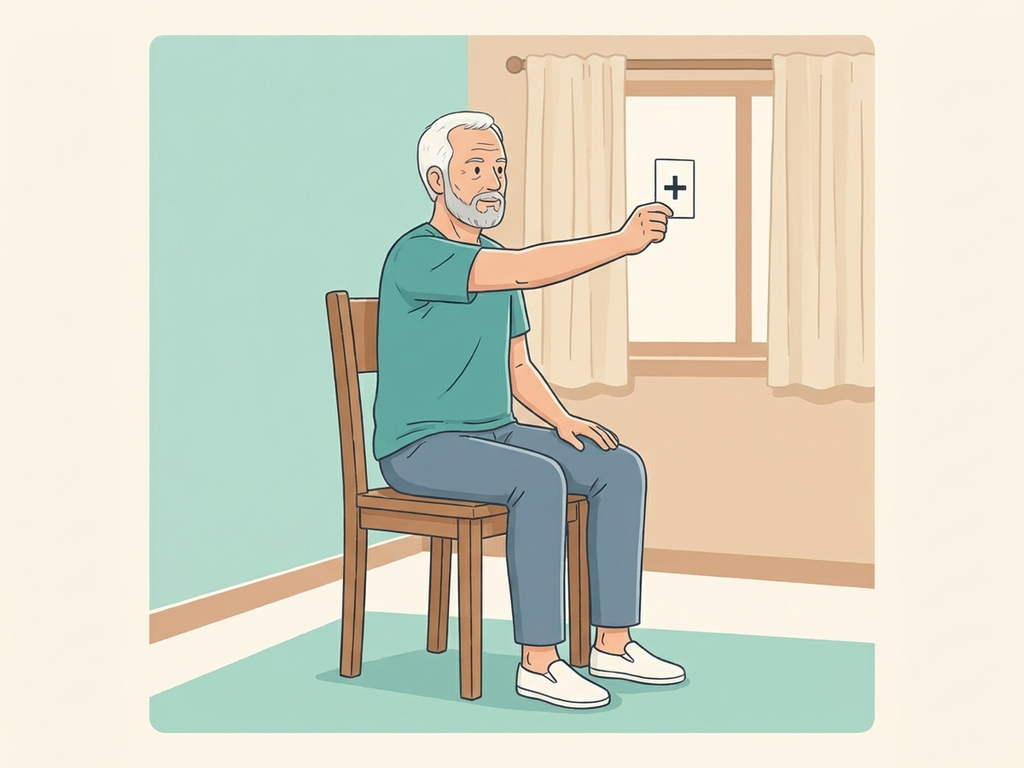
- Setup: Sit near the front of a sturdy chair with no wheels, feet flat on the floor. Hold a small card with a bold letter or symbol at arm’s length, straight in front of your nose at eye level. A business card with a letter drawn on it works well. If your arm gets tired, tape the card to a wall at eye level about an arm’s length away. Wear the glasses you normally use to see at that distance.
- Steps:
- Look at the symbol and bring it into sharp focus.
- Turn your head a short way to the left and right, as if slowly saying “no.” The card stays still.
- Move only as fast as you can while the symbol stays sharp. If it blurs or jumps, slow down.
- Keep going for 30 to 60 seconds. Rest until any dizziness settles, then repeat 2 to 3 times.
- Progression: Gradually turn your head faster while keeping the symbol clear, and lengthen each set toward 1 to 2 minutes as your clinician advises. Later, practice with a target taped to a wall across the room as well as the near card.
- Common Mistakes & Tips: Don’t let the card drift with your head, and don’t let your eyes slip off the target. Keep the turns small. A clear target matters more than a big movement. A mild rise in dizziness during the set is expected.
2. Seated VOR x1, Up and Down
Your head also nods and tilts all day, when you look up at a shelf or down at a step. This version trains the same reflex in the up-and-down direction. One study in the guideline had people practice both directions, sitting and standing, with near and far targets.
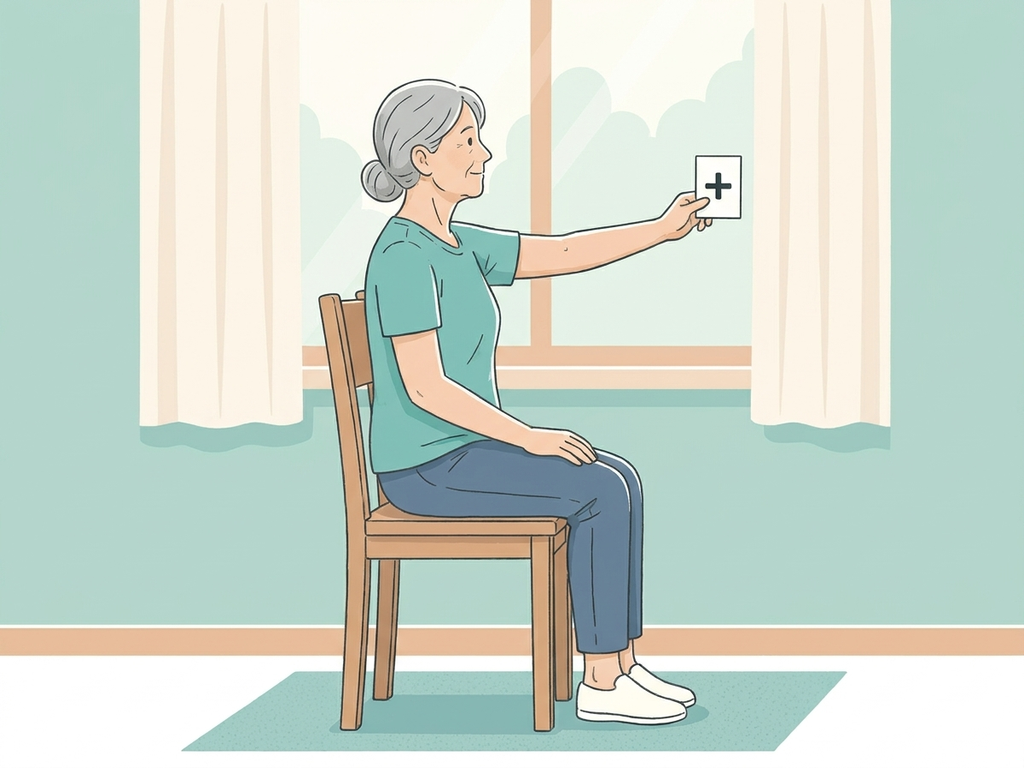
- Setup: The same as exercise 1: sit tall, feet flat, card at arm’s length and eye level.
- Steps:
- Look at the symbol and keep it in focus.
- Nod your head gently up and down, as if slowly saying “yes.” Tip your chin only a little up and a little down.
- Keep the symbol sharp. If it blurs, slow down.
- Continue for 30 to 60 seconds, rest, and repeat 2 to 3 times.
- Progression: The same as exercise 1: a little faster, then longer sets, then a far target. When both directions feel easy seated, move on to exercise 3.
- Common Mistakes & Tips: Move only your head, not your whole upper body. Don’t tip your head far back. If you have neck arthritis or neck pain, keep the movement very small and ask your physical therapist how far to go.
3. Standing VOR x1 at a Kitchen Counter
Standing adds a balance challenge to the same exercise, which brings it closer to daily life. A kitchen counter gives you a solid, heavy surface to hold while you practice.
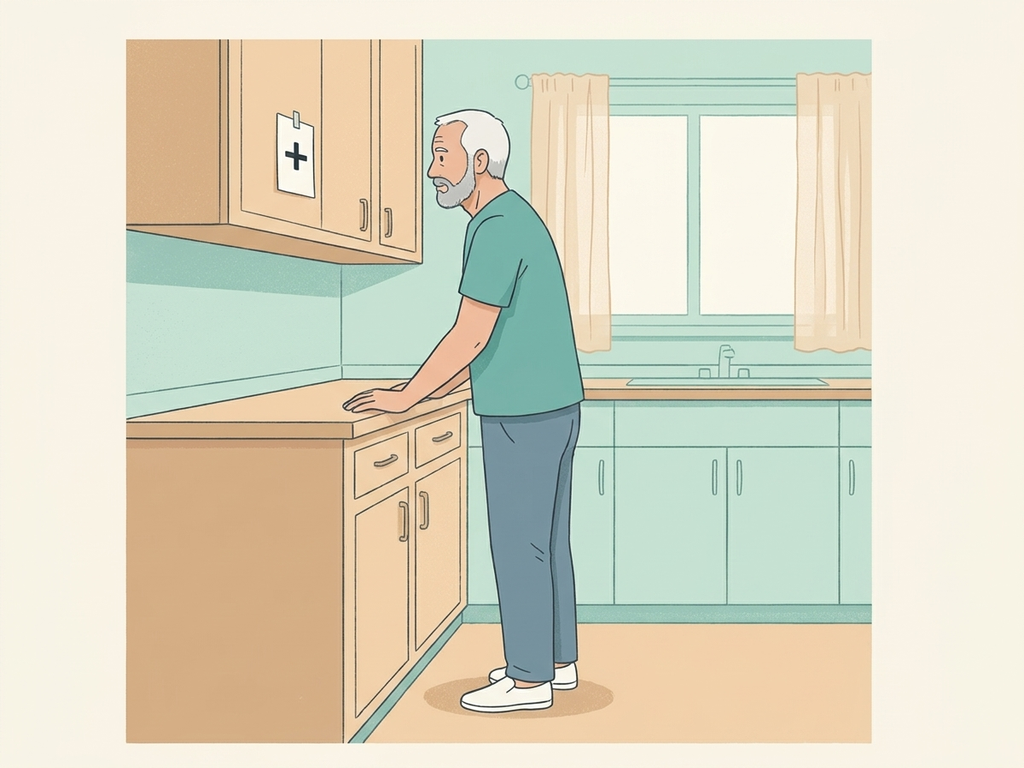
- Setup: Stand facing the kitchen counter with your feet hip-width apart and both hands resting on the edge. Tape the card to the cabinet or wall in front of you at eye level. Put a sturdy chair behind you so you can sit down if you need to.
- Steps:
- Look at the symbol and keep it in focus.
- Turn your head side to side for 30 to 60 seconds, keeping the symbol clear.
- Rest, then do the up-and-down version for 30 to 60 seconds.
- Repeat each direction 2 to 3 times, resting in between.
- Progression: Rest one hand on the counter, then just your fingertips. Stand with your feet closer together, or on a cushion, only if your clinician says it suits you and someone is with you.
- Common Mistakes & Tips: Don’t lock your knees. If you sway, or find yourself gripping the counter hard, go back to sitting at that speed for a few more days.
4. VOR x1 With a Busy Background
Real life rarely gives you a plain wall. Store aisles, patterned carpets and crowds put a lot of visual movement behind whatever you look at, and the guideline gives busy visual environments as an example of places that can bring on symptoms. In one trial described in the guideline, the gaze program began with VOR x1 using near and far targets, moved on to VOR x2 and remembered targets, and then added busy backgrounds.
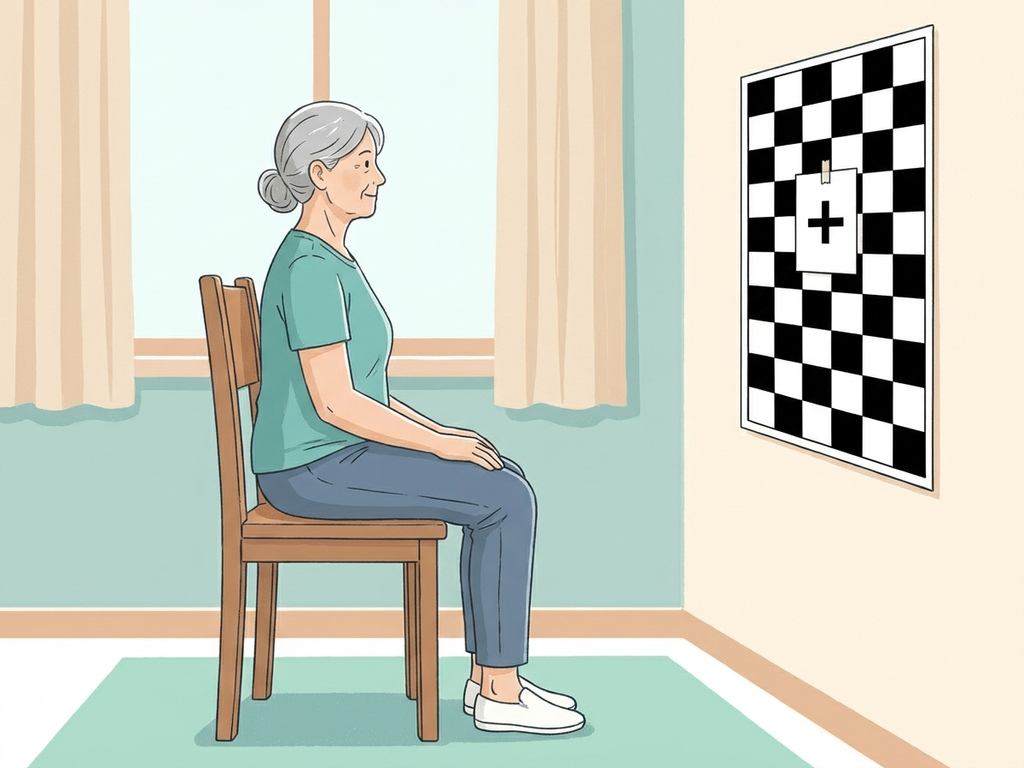
- Setup: Sit facing a wall. Tape the card at eye level onto something busy, such as a checkerboard or striped poster, a patterned curtain or a full bookshelf, about 3 feet (1 meter) away.
- Steps:
- Look at the symbol, not the pattern.
- Turn your head side to side for 30 to 60 seconds, keeping the symbol clear.
- Rest, then do the up-and-down version.
- Repeat each direction 2 to 3 times.
- Progression: Do the same thing standing at the counter, with a patterned sheet taped behind the card.
- Common Mistakes & Tips: Expect this one to feel harder than the plain-wall version. Start slower than your usual speed and build back up. If the pattern makes you feel sick, shorten the set rather than pushing through.
5. VOR x2: Card and Head Move in Opposite Directions
VOR x2 is the advanced version. You move the card one way while you turn your head the other way, so your eyes have to move twice as far for the same head movement. That is where the “x2” comes from. Clinicians usually add it once VOR x1 feels comfortable, so check with yours before you start it.
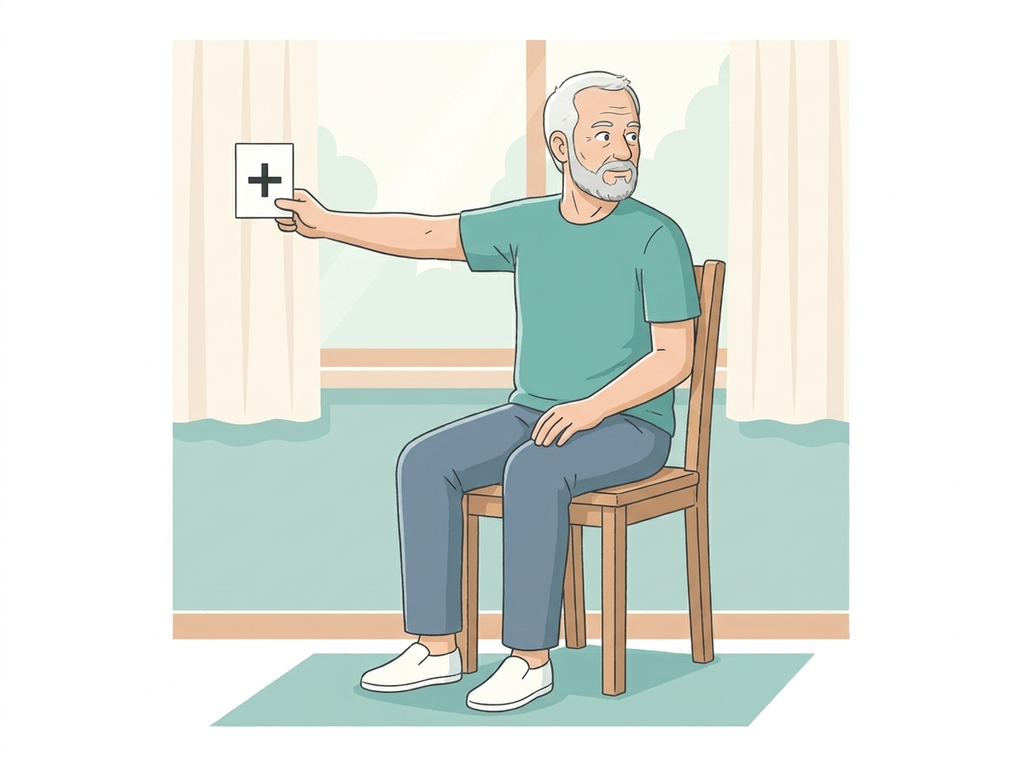
- Setup: Sit tall on a sturdy chair. Hold the card at arm’s length, straight in front of your nose at eye level.
- Steps:
- Move the card a short way to the right while you turn your head to the left, both at the same time. Keep your eyes on the symbol.
- Then move the card to the left while you turn your head to the right.
- Keep both movements small and slow enough that the symbol stays clear.
- Continue for 30 seconds, rest, and repeat once more.
- Progression: Slowly build speed and set length. Add the up-and-down version: lower the card as you tip your chin up, then raise it as you tip your chin down. Try VOR x2 standing only when your clinician says you are ready.
- Common Mistakes & Tips: The card and your head must always move in opposite directions. Moving them the same way is a different exercise. Expect VOR x2 to feel harder than VOR x1, and go slowly at first.
6. Remembered-Target Head Turns (Imaginary Target)
This exercise trains a backup strategy. The 2022 guideline lists remembered-target exercises as substitution exercises: they teach your brain other ways to keep your gaze on target when the inner ear’s signal can’t fully recover.
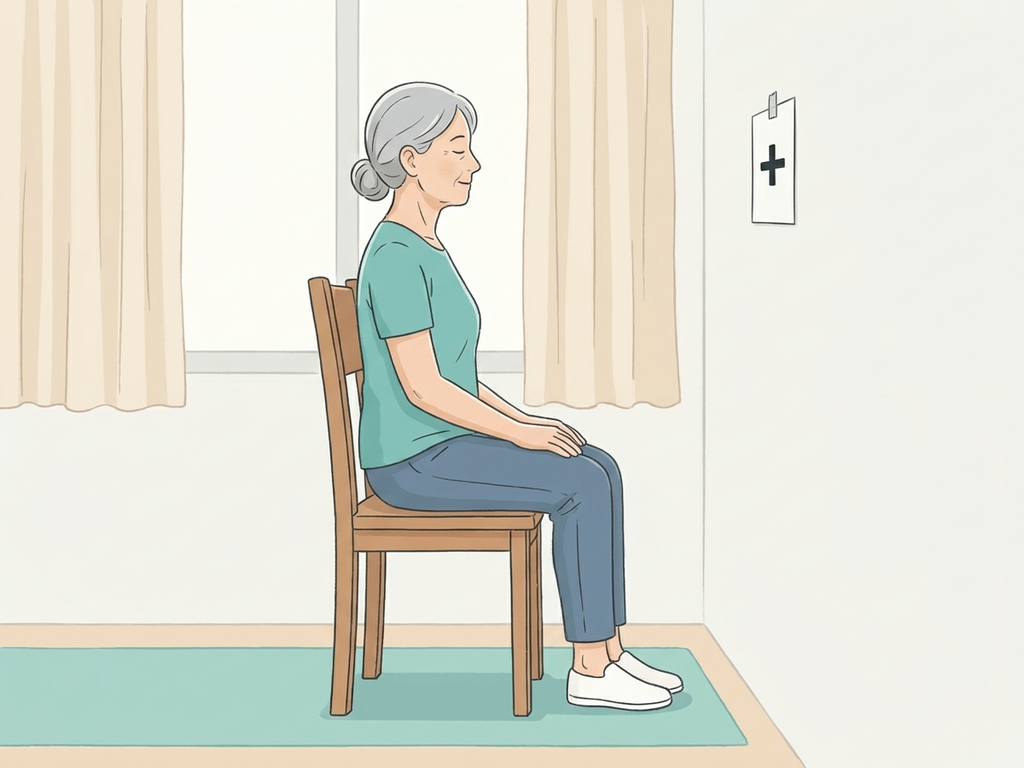
- Setup: Sit tall facing a wall. Tape the card to the wall straight ahead of you at eye level, about 3 feet (1 meter) away.
- Steps:
- Look at the symbol.
- Close your eyes. Slowly turn your head a short way to one side while trying to keep your eyes pointed at where the symbol is.
- Open your eyes. Are you still looking right at the symbol? If not, notice how far off you were and look back at it.
- Return to the center and repeat to the other side. Do 5 to 10 turns to each side.
- Progression: As your accuracy improves, turn a little farther or a little faster. Then try the up-and-down direction.
- Common Mistakes & Tips: Always do this one seated. With your eyes closed, your balance has less information to work with. Accuracy matters more than speed. If you feel off balance, open your eyes.
How often should older adults do gaze stabilization exercises?
The 2022 vestibular rehabilitation guideline suggests a home program of gaze stabilization exercises at least three times a day, plus weekly visits with a physical therapist, with the daily total depending on how long you have had symptoms. The guideline counts the first three months after symptoms start as the acute and subacute stages, and anything longer as chronic.
| Your situation | How often | Total per day | For how long |
|---|---|---|---|
| Recent inner-ear loss on one side (first 3 months) | At least 3 times a day | At least 12 minutes | Not set; your therapist decides |
| Long-standing loss on one side (more than 3 months) | 3 to 5 times a day | At least 20 minutes | 4 to 6 weeks |
| Loss on both sides | 3 to 5 times a day | 20 to 40 minutes | About 5 to 7 weeks |
These are minimums. They come from studies of people whose inner-ear weakness was confirmed with testing, and the guideline rates these dose recommendations as weak. Your therapist may adjust them for you.
Short sessions add up quickly. For example, one minute side to side and one minute up and down, done twice, is a 4-minute session. Three of those spread through the day (morning, midday and evening) make 12 minutes. If 30 seconds is your limit today, start there. The total will grow over the weeks.
How do you know when to make the exercises harder?
Make an exercise harder when you can finish a full set with the target clear the whole time, your symptoms rise only mildly and settle soon after, and you feel steady in that position. Change one thing at a time: speed, set length, position, hand support, background or target distance.
| Stage | What to do | Move on when |
|---|---|---|
| 1 | Exercises 1 and 2, seated, plain wall, slow speed | The symbol stays clear for a full set |
| 2 | The same, a little faster, longer sets, then a far target across the room | Symptoms settle soon after each set |
| 3 | Exercise 3 standing at the counter, both hands, then one hand | You stay steady without gripping the counter |
| 4 | Exercise 4 with a busy background, plus exercises 5 and 6 if your clinician agrees | Your clinician guides the next step, such as head turns while walking |
If symptoms are still clearly worse hours later or the next day, go back one step for a few days. Moving back down is part of the process, not a failure.
Is it normal to feel dizzy during gaze stabilization exercises?
Yes, a mild rise in dizziness during the exercise is normal, as long as it settles soon after you stop. The 2022 guideline lists temporary dizziness during and after the exercises as a known risk. It says patients should be told that a short-term increase in symptoms is likely and “does not seem to affect long-term outcomes.” In studies the guideline reviewed, this extra dizziness faded within the first two to five weeks of training.
A simple way to judge your dose:
- Before you start: Rate your dizziness from 0 (none) to 10 (worst).
- During the set: A mild rise that you can tolerate is fine. If the symbol keeps blurring, slow down.
- Between sets: Rest until you are back near your starting level.
- Later that day: If you are still clearly worse hours later, or worse the next morning, do less next time: slower, shorter or fewer sets.
- Stop and sit: Stop if you feel faint, very sick to your stomach, or the room keeps spinning after you stop.
Who should see a clinician first, and what are the red flags?
See a doctor or vestibular physical therapist before you start these exercises if any of these apply:
- New dizziness that hasn’t been checked: The cause matters. The guideline’s advice is based on people whose inner-ear weakness was confirmed with testing.
- Short spells of spinning when you lie down, roll over in bed or look up: This pattern often comes from BPPV, a loose-crystal problem in the inner ear. A Cochrane review found that repositioning maneuvers worked better than exercise for BPPV in the short term. See vertigo exercises for older adults.
- Dizzy attacks with hearing changes, ringing or fullness in one ear: These need a diagnosis before you train.
- Lightheadedness when you stand up: This can be a blood pressure problem, which gaze exercises won’t fix.
- Neck pain, neck arthritis or recent neck surgery: Ask how far and how fast you can safely turn your head.
- A recent fall, or trouble standing without support: Stay with the seated exercises until a clinician checks your balance.
Stop and call your doctor the same day for sudden hearing loss or a sudden change in hearing in one ear. The sudden hearing loss guideline notes that prompt recognition and treatment may improve hearing recovery. Also call the same day if your dizziness is getting steadily worse over several days instead of better, or if you have nearly fainted.
Call emergency services if sudden new vertigo or unsteadiness comes with double vision, trouble speaking, a drooping face, weakness or numbness on one side of the body, or trouble walking, as these can be signs of a stroke. Also call for chest pain, fainting or a sudden severe headache.
Key Takeaways
- Keep the target clear: Speed helps only as long as the symbol stays sharp. If it blurs, slow down.
- Your head has to move: Gaze stabilization works through head movement. Eye-only exercises are not a substitute.
- Little and often: The guideline suggests at least three sessions a day, adding up to at least 12 minutes for a recent problem and more for a long-standing one.
- Mild dizziness that settles is expected: A short-term rise in symptoms is common in the first weeks and does not seem to harm long-term results.
- Age is not a barrier: Older adults can expect good results from vestibular therapy. Get checked first if your dizziness is new, comes in spinning spells when you lie down, or comes with hearing changes.
Build Your Routine with EyeRehab
Gaze stabilization works best a little and often, which can be hard to keep up on your own. The EyeRehab - VOR Training app guides you through VOR x1, VOR x2 and imaginary-target exercises, along with saccades, smooth pursuits, optokinetic and static balance training. Before and after each session, it asks you to rate dizziness, brain fog, headache, eye strain and nausea from 0 to 10, so you have a record of how each session affected you, and it adjusts the difficulty as you improve. The app is free for patients, and your clinician can assign your program from their portal.
Would you rather work with someone in person? Find a vestibular clinician near you. Physical therapists can use EyeRehab with their patients to assign home exercise programs and follow progress between visits.
Medical Disclaimer
This content is for informational and educational purposes only and does not constitute medical advice, diagnosis or treatment. Talk to your doctor or physical therapist before starting gaze stabilization exercises, especially if your dizziness is new, you have fallen recently, or you have neck problems, hearing changes or heart problems. If you have sudden severe dizziness, sudden hearing loss, double vision, trouble speaking or weakness on one side of the body, seek medical attention immediately.
Related reading
Frequently Asked Questions
What gaze stabilization exercises help older adults with dizziness?
The core exercise is VOR x1: keep your eyes on a small target while you turn your head side to side, then while you nod up and down. Do it seated first, then standing at a kitchen counter, then against a busy background. VOR x2, where the card and your head move in opposite directions, and remembered-target head turns are usually added later with a clinician's guidance. Moving only your eyes while your head stays still does not train gaze stability.
How often should older adults do gaze stabilization exercises?
The 2022 vestibular rehabilitation guideline suggests a home program of at least three sessions a day, plus weekly visits with a physical therapist. For a recent inner-ear loss on one side, that adds up to at least 12 minutes a day. For a one-sided loss that has lasted more than three months, it suggests 3 to 5 sessions a day totaling at least 20 minutes, for 4 to 6 weeks. A loss on both sides calls for 20 to 40 minutes a day for about 5 to 7 weeks.
How do you know when to make the exercises harder?
Move up a step when you can finish a full set with the target clear the whole time, your dizziness rises only mildly and settles soon after, and you feel steady in that position. Change one thing at a time: a little more speed, a longer set, standing instead of sitting, less hand support or a busier background. If you are still worse hours later or the next day, go back a step.
Is it normal to feel dizzy during gaze stabilization exercises?
Yes. A mild rise in dizziness during the exercise is expected, as long as it settles soon after you stop. The 2022 guideline says patients should be told that a short-term increase in symptoms is likely and does not seem to affect long-term results. In studies it reviewed, this extra dizziness faded within the first two to five weeks of training. Stop and get help for fainting, sudden hearing loss, double vision, trouble speaking or weakness on one side.
Tags
Written by
EyeRehab - VOR Training Team
Expert insights on vestibular rehabilitation and eye health.
Related Articles

What Happens to Your Eyes During BPPV? Nystagmus Explained
During BPPV, your eyes jerk in a pattern called nystagmus. See what it looks like, how the Dix-Hallpike test reads it and why it decides your maneuver.
EyeRehab - VOR Training Team
November 20, 2026
How to Record Nystagmus With Your Phone for Your Doctor
How to film nystagmus on your phone so your doctor can see it: safety first, light, distance, a step-by-step checklist, and what a 2026 UCL study found.
EyeRehab - VOR Training Team
November 20, 2026
Is Nystagmus Dangerous? Warning Signs and When to Get Help
Nystagmus itself isn't dangerous, but its cause can be. Learn the stroke warning signs, what the HINTS exam is, and when to see a doctor or go to the ER.
EyeRehab - VOR Training Team
November 20, 2026