Vertigo Exercises for Older Adults: 6 Safe Options for Home
6 vertigo exercises for older adults: Brandt-Daroff for confirmed BPPV, plus gaze and balance exercises for lingering dizziness, with doses and warning signs.
EyeRehab - VOR Training Team
Published on November 13, 2026

Listen to this article
Natural Language Narration · 18 min
Quick answer
What vertigo exercises are safe for older adults?
Safe vertigo exercises for older adults depend on the cause. If a clinician confirms BPPV, an Epley maneuver done in the clinic is the main treatment, and Brandt-Daroff exercises are a home option with weaker evidence. For dizziness or unsteadiness that lingers, seated and standing VOR x1, standing head turns, walking with head turns and sit-to-stands help, with support within reach.
Reviewed on November 13, 2026
Why Vertigo in Older Adults Needs a Diagnosis First
Vertigo is the false feeling that you or the room is spinning. In older adults, a common cause is benign paroxysmal positional vertigo, or BPPV. Tiny calcium crystals in the inner ear drift into one of its balance canals, and certain moves, such as rolling over in bed or looking up, set off a short spell of spinning. The American Academy of Otolaryngology–Head and Neck Surgery (AAO-HNS) calls BPPV the most common cause of vertigo and says it is more common in older people.
BPPV is also easy to miss in older adults. In seniors it can show up as unsteadiness when sitting up, looking up, bending over or reaching, rather than clear spinning. In one study of older patients in an inner-city area, 9% had BPPV that had never been diagnosed, and those patients were more likely to have fallen in the previous three months. That is why the right vertigo exercises for older adults depend on the cause. One exercise below treats BPPV itself. The others help the dizziness and unsteadiness that can linger.
What vertigo exercises are safe for older adults?
The safest vertigo exercises for older adults are the ones matched to the cause: Brandt-Daroff exercises for BPPV that a clinician has confirmed, and gaze stabilization and supported balance exercises for dizziness or unsteadiness that lingers.
Before you start any of them, a clinician should check what kind of vertigo you have. For BPPV, the usual test is the Dix-Hallpike test. The clinician moves you from sitting to lying back with your head turned 45 degrees to one side and tipped slightly back, then watches your eyes. The pattern of eye movement shows whether it is BPPV and which ear and canal are involved. The 2017 AAO-HNS guideline says BPPV in the posterior canal should be treated with a repositioning procedure, such as the Epley maneuver, or referred to a clinician who can do one.
Exercise 1 is for BPPV only. Exercises 2 to 6 are for dizziness and unsteadiness that remain. They do not move the crystals.
| Exercise | Position/Setup | Starting dose | Level |
|---|---|---|---|
| 1. Brandt-Daroff exercises | Sitting on the edge of a bed, then lying on each side | 5 repetitions, 3 times a day, for 2 weeks | For confirmed BPPV only, with your clinician’s okay |
| 2. Seated VOR x1 | Seated, card at arm’s length | 30 to 60 seconds, 2 to 3 times | Beginner (lingering dizziness) |
| 3. Standing VOR x1 at a counter | Standing, one hand on the counter | 30 to 60 seconds, 2 to 3 times | Intermediate (lingering dizziness) |
| 4. Standing head turns at a counter | Standing, both hands on the counter | 10 turns, 2 sets | Beginner to intermediate (unsteadiness) |
| 5. Walking with head turns | Hallway, wall or rail within reach | 2 to 4 lengths of the hallway | Intermediate to advanced (unsteadiness) |
| 6. Sit-to-stand | Sturdy chair against a wall | 5 to 10, building to 10 to 15 | Beginner to intermediate (unsteadiness) |
1. Brandt-Daroff Exercises (for BPPV)
Brandt-Daroff exercises repeat the moves that set off BPPV, a few times a day. It is not fully clear how they work. They may help shift loose crystals, or your brain may get used to the spinning. They are easier to do alone than an Epley maneuver, but the evidence is weaker. A Cochrane review found one trial in which the Epley maneuver worked better than a week of Brandt-Daroff exercises done three times a day. Some clinicians do an Epley in the clinic and then suggest Brandt-Daroff exercises at home, because they are easier to do without help.
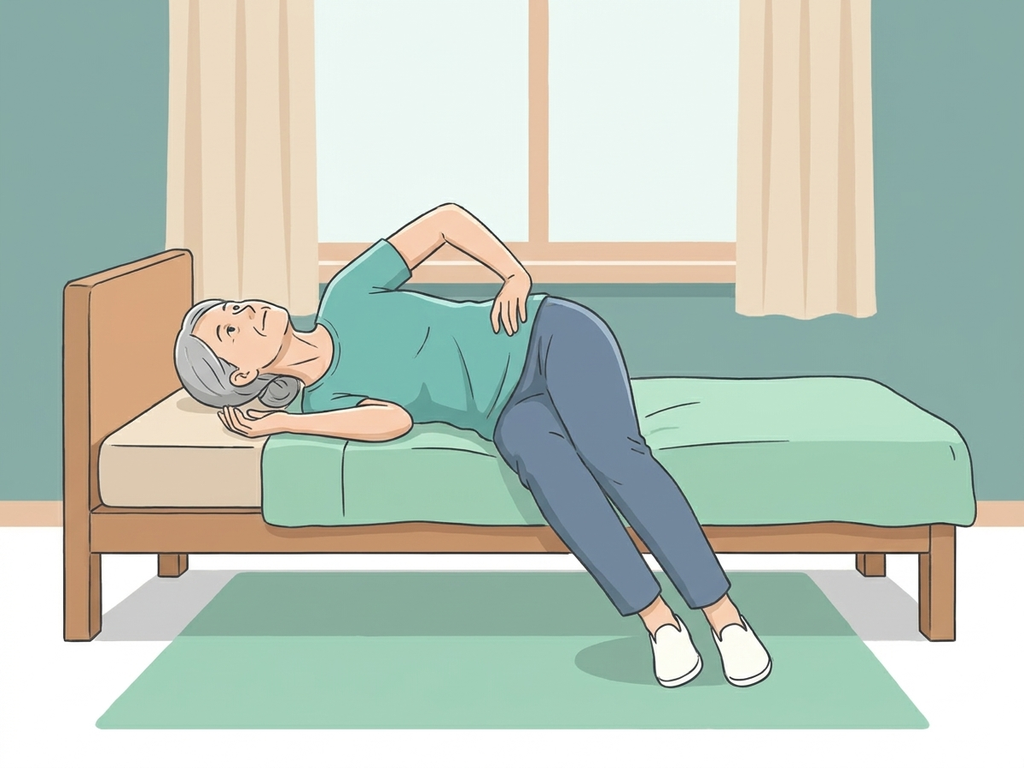
- Setup: Only do these if a clinician has confirmed BPPV and said they suit you. Sit upright on the edge of your bed, near the middle, with your feet on the floor. Make sure there is room on both sides for your body and head to land on the mattress. Have someone with you the first few times.
- Steps:
- Turn your head 45 degrees to the left, or as far as is comfortable.
- Keeping your head turned, lie down quickly but under control onto your right side. Your face now points up toward the ceiling at an angle.
- Stay there for 30 seconds, or until the spinning stops if that takes longer.
- Sit back up, face forward and wait 30 seconds.
- Turn your head 45 degrees to the right and lie down on your left side the same way. Stay 30 seconds, or until the spinning stops.
- Sit back up, face forward and wait 30 seconds. That is one repetition.
- Do 5 repetitions in a row, 3 times a day (morning, afternoon and evening), for 2 weeks.
- Progression: There is no harder version. If spinning still happens after two weeks, or gets worse, stop and see your clinician. Another repositioning maneuver may be needed, or a different one if another canal is involved.
- Common Mistakes & Tips: Brief spinning when you lie down is expected. Stay in the position until it settles. Use a firm bed, not a sofa or a narrow bed you could roll off. When you finish a set, stay sitting on the edge of the bed until the dizziness has passed and you feel steady, because your balance can be off for a while afterward.
2. Seated VOR x1 (Gaze Stabilization)
After BPPV is treated, many people still feel sensitive to movement or unsteady for a few days to a few weeks. The AAO-HNS notes that older adults who have fallen or fear falling may need more exercises or balance therapy. Gaze stabilization exercises train the vestibulo-ocular reflex (VOR), which keeps your vision steady while your head moves. The 2022 vestibular rehabilitation guideline found strong evidence for vestibular exercise in people with inner-ear weakness, and your clinician may suggest it for dizziness that lingers.
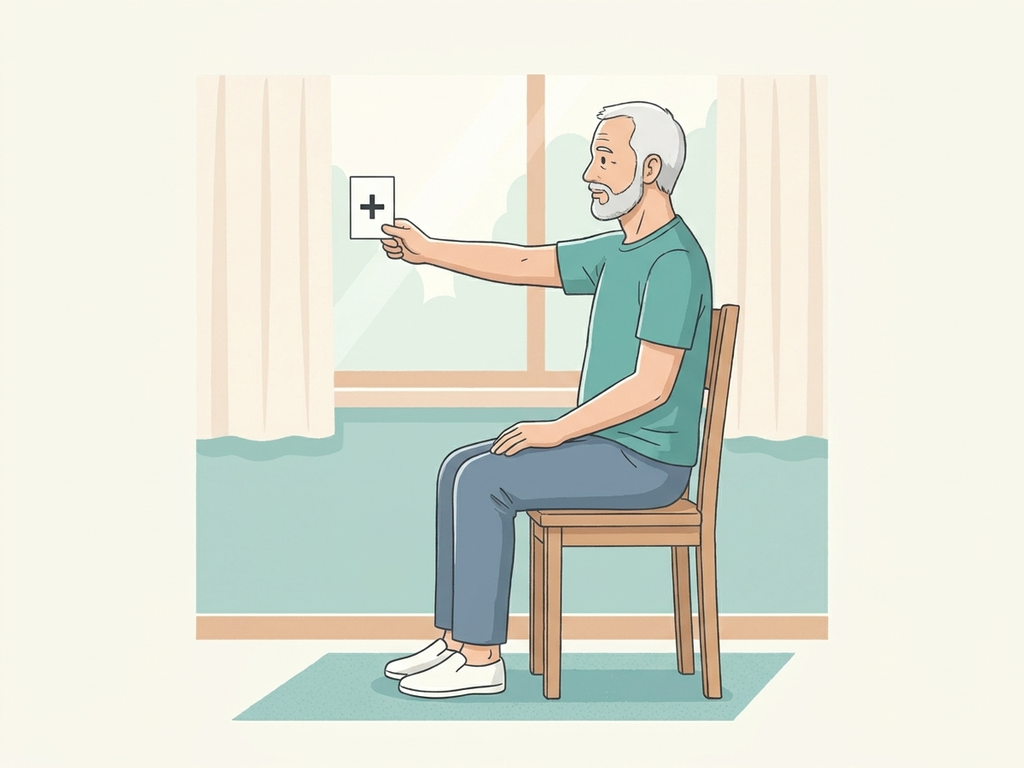
- Setup: Sit upright on a sturdy chair. Hold a card with a letter or symbol on it (a business card works) at arm’s length, straight in front of your nose at eye level.
- Steps:
- Keep your eyes on the card.
- Turn your head slowly a short distance left and right, as if saying “no,” while the card stays still.
- Keep the letter in focus. If it blurs, slow down.
- Continue for 30 to 60 seconds, rest, and repeat 2 to 3 times.
- Do this up to three times a day if your clinician agrees.
- Progression: Turn a little faster while keeping the target clear, add up-and-down (“yes”) head movements, or put the card against a busier background. When this feels easy, move on to exercise 3.
- Common Mistakes & Tips: Move your head, not the card. Mild dizziness that settles soon after you stop is common. A burst of true spinning when you turn your head is different. It can mean BPPV is still there, so stop and tell your clinician.
3. Standing VOR x1 at a Counter
Doing the same exercise standing adds a balance challenge, closer to real life, where you turn your head while on your feet. A kitchen counter gives you something solid to hold.
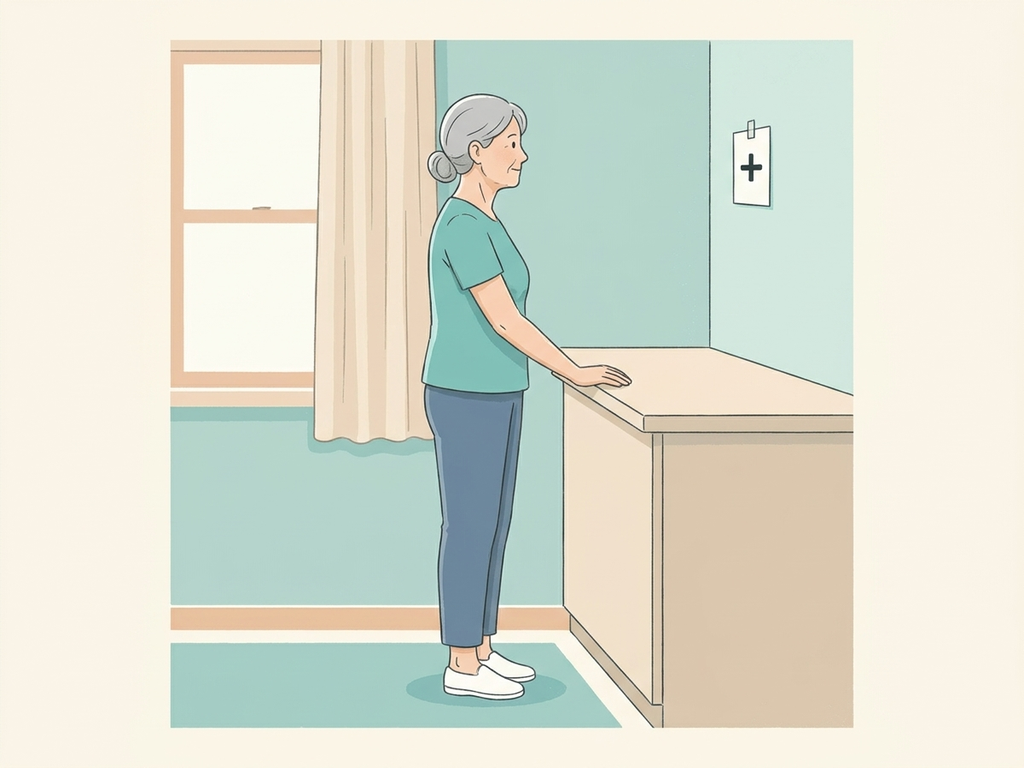
- Setup: Stand facing the counter with your feet hip-width apart and one hand resting on the countertop. Tape a card with a letter or symbol to the wall at eye level, an arm’s length away or a little farther. Put a sturdy chair behind you so you can sit down.
- Steps:
- Keep your eyes on the card.
- Turn your head slowly left and right while the letter stays in focus.
- Continue for 30 to 60 seconds.
- Sit down and rest, then repeat 2 to 3 times.
- Progression: Rest only your fingertips on the counter, then let your hand hover just above it. Later, stand with your feet closer together or add up-and-down head movements. Try foam or a cushion under your feet only if your clinician suggests it, with someone beside you.
- Common Mistakes & Tips: Stand close enough to grab the counter without reaching. If you feel more than mildly dizzy, sit down and go back to the seated version for a few days.
4. Standing Head Turns at a Counter
Turning your head to look around, at a doorway, a sound or a person talking to you, is a common moment of unsteadiness after vertigo. This exercise practices keeping your balance while your head turns and your eyes go with it.
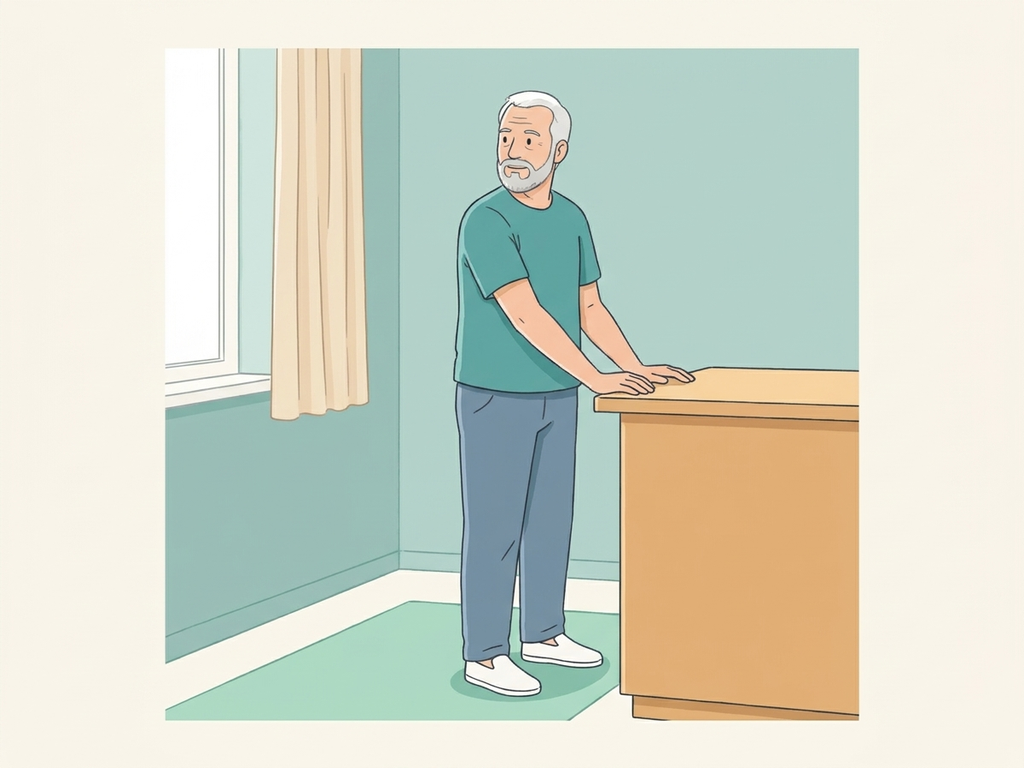
- Setup: Stand at the counter with both hands resting lightly on it and your feet hip-width apart. Keep a chair behind you.
- Steps:
- Turn your head slowly to look over your left shoulder.
- Pause for one to two seconds, then bring your head back to center.
- Turn your head slowly to look over your right shoulder, pause, and return to center.
- Do 10 turns, alternating sides. Rest, then do a second set.
- Progression: Hold the counter with one hand, then with fingertips only. Later, stand with your feet closer together, or add looking up toward the ceiling and down toward the floor.
- Common Mistakes & Tips: Keep your shoulders still and move only your head. If looking up or turning your head sets off a burst of spinning, stop and tell your clinician. That can be a sign BPPV is back.
5. Walking With Head Turns in a Hallway
Walking while you look around is something you do every time you go out. It is also one of the harder balance tasks after vertigo. A hallway with a wall or handrail within reach is a safe place to practice it.
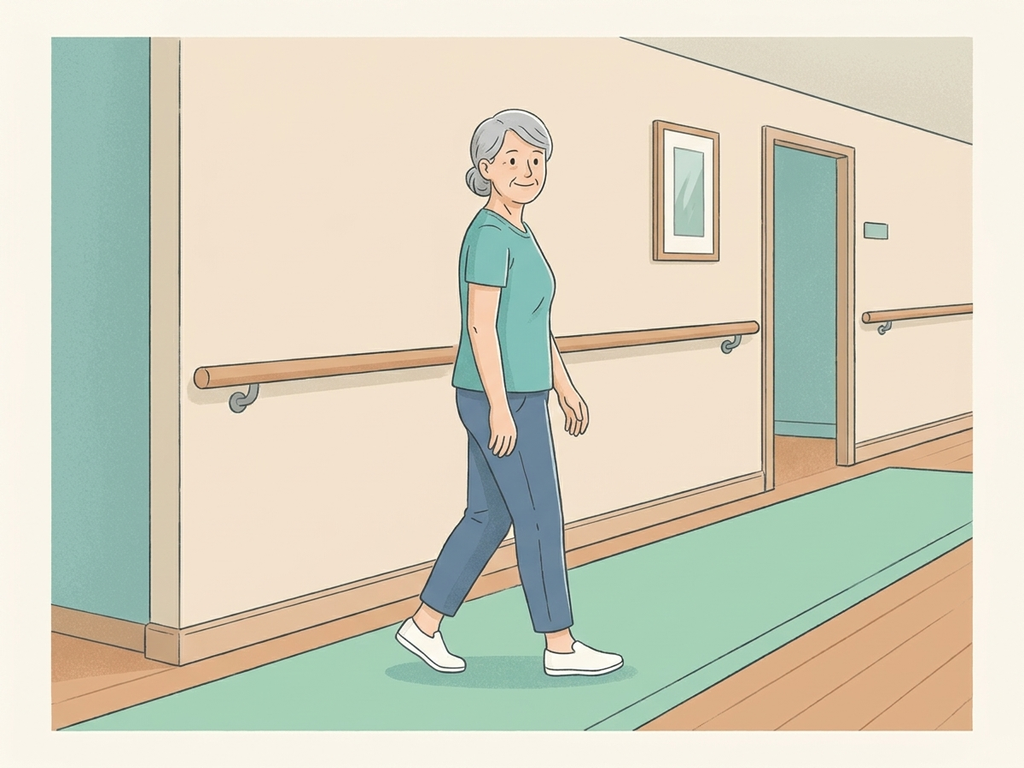
- Setup: Choose a hallway at least 10 steps long, clear of rugs, cords and clutter, with a wall or handrail within reach on one side. Wear supportive closed shoes. Have someone walk beside you the first few times. If you normally use a cane, use it.
- Steps:
- Walk one length of the hallway at a slow, steady pace, looking straight ahead.
- On the next length, turn your head to the right for 2 to 3 steps, then look forward, then turn your head to the left for 2 to 3 steps.
- Keep walking in a straight line while your head turns.
- At the end, stop and stand still before you turn around slowly.
- Do 2 to 4 lengths with head turns, resting between them.
- Progression: Turn your head more often, walk a little faster, or add up-and-down head movements. Move to open spaces or outdoors only when the hallway feels easy and steady.
- Common Mistakes & Tips: If you drift or stagger, slow down, turn your head less and touch the wall. Turning around at the end is a balance challenge of its own, so take small steps.
6. Sit-to-Stand
In some older adults, BPPV shows up mainly as unsteadiness when they change position, such as sitting up or bending over. Standing up from a chair trains strength and balance together. The World Falls Guidelines give it as an example of the functional exercise that prevents falls, and the CDC recommends it to older adults as the “chair rise” exercise.
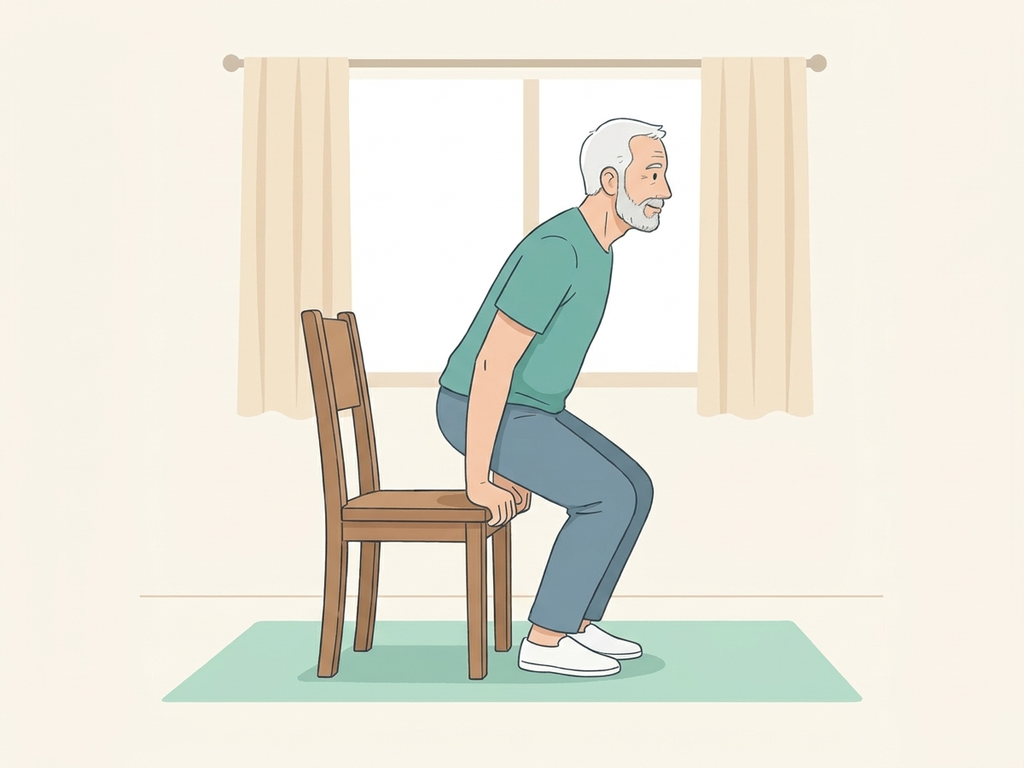
- Setup: Put a sturdy chair against a wall so it can’t slide. Sit near the front of the seat with your feet flat, hip-width apart and slightly behind your knees.
- Steps:
- Rest your hands lightly on the seat beside your thighs.
- Lean forward until your nose is over your toes.
- Push through your heels and stand up, using your hands as little as possible.
- Stand tall, look at a fixed point ahead and pause for about five seconds.
- Lower yourself slowly until you are sitting.
- Start with 5 to 10 and work up to 10 to 15.
- Progression: Use one hand, then no hands with your arms crossed over your chest. Take three to five seconds to sit back down.
- Common Mistakes & Tips: Use the same habit when you get out of bed: sit on the edge for a moment, stand, and pause before you walk. Feeling lightheaded or faint when you stand is different from spinning, so tell your doctor about it.
Should older adults do the Epley maneuver at home?
Not as a first step. The Epley maneuver is the main treatment for BPPV in the posterior canal, and it is best done first by a clinician who has confirmed which ear and which canal are involved.
The Epley is well studied. A Cochrane review of 11 trials found it safe and effective. In the trials that compared it with a fake maneuver or no treatment, the share of people whose vertigo went away completely rose from 21% to 56%. The review also notes that some people could not tolerate the maneuver because of neck problems. The AAO-HNS says repositioning works for about 80% of people, though it sometimes needs to be repeated.
The AAO-HNS suggests having a health professional do the maneuver if:
- your symptoms are severe and disabling
- you are an older adult who has fallen before or fears falling
- stiffness in your neck or back, or weakness, makes moving hard
A clinician can also teach you to do it yourself, which the AAO-HNS calls self-repositioning. If they do, follow their written instructions for your side. This article does not give step-by-step home Epley instructions. A maneuver for one ear or canal does not treat another, and the positions put strain on the neck. The 2017 guideline also advises against strict rules on how you sleep or move after an Epley for posterior-canal BPPV. It recommends a follow-up check within a month to see whether the BPPV has cleared.
How often should older adults do vertigo exercises?
It depends on the exercise. Brandt-Daroff exercises are usually done 3 times a day for 2 weeks. Gaze and balance exercises are usually done most days for several weeks, at a dose your clinician sets.
The 2022 vestibular rehabilitation guideline gives doses for people with inner-ear weakness. For long-standing weakness on one side, it suggests gaze exercises 3 to 5 times a day for a total of at least 20 minutes daily, for 4 to 6 weeks, and balance exercises for at least 20 minutes daily for 4 to 6 weeks. Many older adults start well below that and build up. Lingering dizziness after BPPV is a different problem, so your clinician will set your dose.
Here is a sample plan. Your clinician may change it to suit you.
| Stage | What to do | How often |
|---|---|---|
| First | See a clinician to confirm the cause, with a Dix-Hallpike test if BPPV is suspected | Once |
| If BPPV is confirmed | Epley maneuver in the clinic. Brandt-Daroff exercises at home only if your clinician suggests them | Brandt-Daroff: 5 repetitions, 3 times a day, for 2 weeks |
| Within a month | Follow-up visit to check that the BPPV has cleared | Once |
| If dizziness or unsteadiness lingers, weeks 1–2 | Exercises 2, 4 and 6 | 5 to 10 minutes, 1 to 3 times a day |
| Weeks 3–6 | Add exercises 3 and 5, and use less support | 10 to 20 minutes a day, most days |
How can older adults do vertigo exercises safely?
Check with your clinician before positional exercises like Brandt-Daroff if any of these apply:
- Neck or back problems: Arthritis, a stiff neck, a past neck injury or back pain can make lying down quickly with your head turned unsafe or painful.
- Recent surgery: Ask your surgeon or clinician when it is safe to lie down quickly and turn your head.
- Falls or fear of falling: Have someone with you, at least for the first few sessions.
During and after the exercises:
- Sit for a while afterward: Your balance can be off for a while after the spinning stops. Stay seated until you feel steady before you stand or walk.
- Keep support within reach: Use a counter, a wall or a sturdy chair behind you for every standing exercise. Clear rugs and clutter, and wear supportive closed shoes.
- Know what BPPV feels like: It comes in short spells set off by changes in head position. It does not cause constant severe dizziness, hearing loss or fainting. If your symptoms don’t fit that pattern, see a doctor before you exercise.
- Stop when something feels wrong: Sit down if you feel faint, short of breath or more than mildly dizzy.
When vertigo could be a stroke
Sometimes sudden vertigo is a sign of a stroke in the back of the brain. Call emergency services right away if vertigo comes with any of these:
- double vision or sudden loss of vision
- trouble speaking, slurred speech or trouble swallowing
- a drooping face
- weakness or numbness in the face, an arm or a leg, especially on one side
- a sudden, severe headache with no known cause
- sudden confusion
- being unable to walk or stand without falling
- sudden hearing loss
Don’t wait to see whether it passes, and don’t try any exercises. Also call emergency services for chest pain or fainting.
Key Takeaways
- Find the cause first: BPPV is a common, treatable cause of vertigo in older adults, and it is often missed. A clinician can confirm it with a Dix-Hallpike test.
- The Epley comes first for BPPV: It is best done by a clinician who knows your side and canal. Brandt-Daroff exercises are a home option with weaker evidence.
- Different exercises do different jobs: Gaze and balance exercises help lingering dizziness and unsteadiness, but they do not move the crystals.
- Support within reach, every time: Start seated, then stand at a counter, then walk in a hallway, using less support as you improve.
- Know the stroke signs: Vertigo with double vision, trouble speaking or swallowing, a drooping face or one-sided weakness is an emergency.
Build Your Routine with EyeRehab
Once a clinician has confirmed what is causing your vertigo, the EyeRehab - VOR Training app can guide your home exercises. It includes VOR x1, VOR x2, static balance and Brandt-Daroff exercises, tracks your symptoms before and after each session, and adjusts the difficulty as you improve. It does not diagnose BPPV or choose a repositioning maneuver for you. The app is free for patients.
Would you rather work with someone in person? Find a vestibular clinician near you. Physical therapists can use EyeRehab with their patients to assign home exercise programs and follow progress between visits.
Medical Disclaimer
This content is for informational and educational purposes only and does not constitute medical advice, diagnosis or treatment. Vertigo has many causes, and some are serious. See your doctor or a vestibular clinician before starting these exercises, especially if you have neck or back problems, have had recent surgery or have fallen recently. If vertigo comes on suddenly with double vision, trouble speaking or swallowing, facial drooping, or weakness or numbness on one side, call emergency services immediately.
Related reading
Frequently Asked Questions
What vertigo exercises are safe for older adults?
The safe choice depends on the cause, so have a clinician check first. For BPPV that a clinician has confirmed, Brandt-Daroff exercises are a home option, usually 5 repetitions three times a day for two weeks. For dizziness or unsteadiness that lingers, gaze stabilization (VOR x1) seated and then standing at a counter, standing head turns, walking with head turns in a hallway and sit-to-stands are good choices, always with support within reach.
Should older adults do the Epley maneuver at home?
Not as a first step. The Epley maneuver treats posterior-canal BPPV, and a clinician should first confirm which ear and which canal are involved, usually with the Dix-Hallpike test. The AAO-HNS suggests having a professional do the maneuver if you are an older adult who has fallen or fears falling, or if neck or back stiffness makes moving hard. Your clinician can then teach you a home version for your side if it suits you.
How often should older adults do vertigo exercises?
Brandt-Daroff exercises are usually done 5 times in a row, three times a day, for two weeks. Gaze stabilization and balance exercises are usually done most days for several weeks. For people with inner-ear weakness, the 2022 vestibular rehabilitation guideline suggests gaze exercises at least three times a day. Older adults often start with shorter sessions and build up. A follow-up visit within a month checks whether BPPV has cleared.
Is it normal to feel dizzy during vertigo exercises?
Some dizziness is expected. Brandt-Daroff exercises are meant to bring on brief spinning, and gaze exercises often cause mild dizziness that settles soon after you stop. Sit down and rest until it passes. Stop and call your clinician if it is strong, lasts, or keeps getting worse. Call emergency services if vertigo comes with double vision, trouble speaking or swallowing, a drooping face, or weakness or numbness on one side.
Tags
Written by
EyeRehab - VOR Training Team
Expert insights on vestibular rehabilitation and eye health.
Related Articles

What Happens to Your Eyes During BPPV? Nystagmus Explained
During BPPV, your eyes jerk in a pattern called nystagmus. See what it looks like, how the Dix-Hallpike test reads it and why it decides your maneuver.
EyeRehab - VOR Training Team
November 20, 2026

How to Record Nystagmus With Your Phone for Your Doctor
How to film nystagmus on your phone so your doctor can see it: safety first, light, distance, a step-by-step checklist, and what a 2026 UCL study found.
EyeRehab - VOR Training Team
November 20, 2026

Is Nystagmus Dangerous? Warning Signs and When to Get Help
Nystagmus itself isn't dangerous, but its cause can be. Learn the stroke warning signs, what the HINTS exam is, and when to see a doctor or go to the ER.
EyeRehab - VOR Training Team
November 20, 2026