Vertiges dans les supermarchés : Guide du vertige visuel
Un guide pratique sur les vertiges en supermarché, le vertige visuel, la gestion du rythme et le retour progressif dans les environnements visuellement chargés.
EyeRehab - VOR Training Team
Publié le 15 juin 2026
Écouter cet article
Narration Kokoro-MLX · 7 min
Réponse courte
Why do grocery stores make some people dizzy?
A practical guide to grocery-store dizziness, visual vertigo, pacing, and graded return to busy visual environments.
Révisé le 15 juin 2026
Why Do Grocery Stores Make Some People Dizzy?
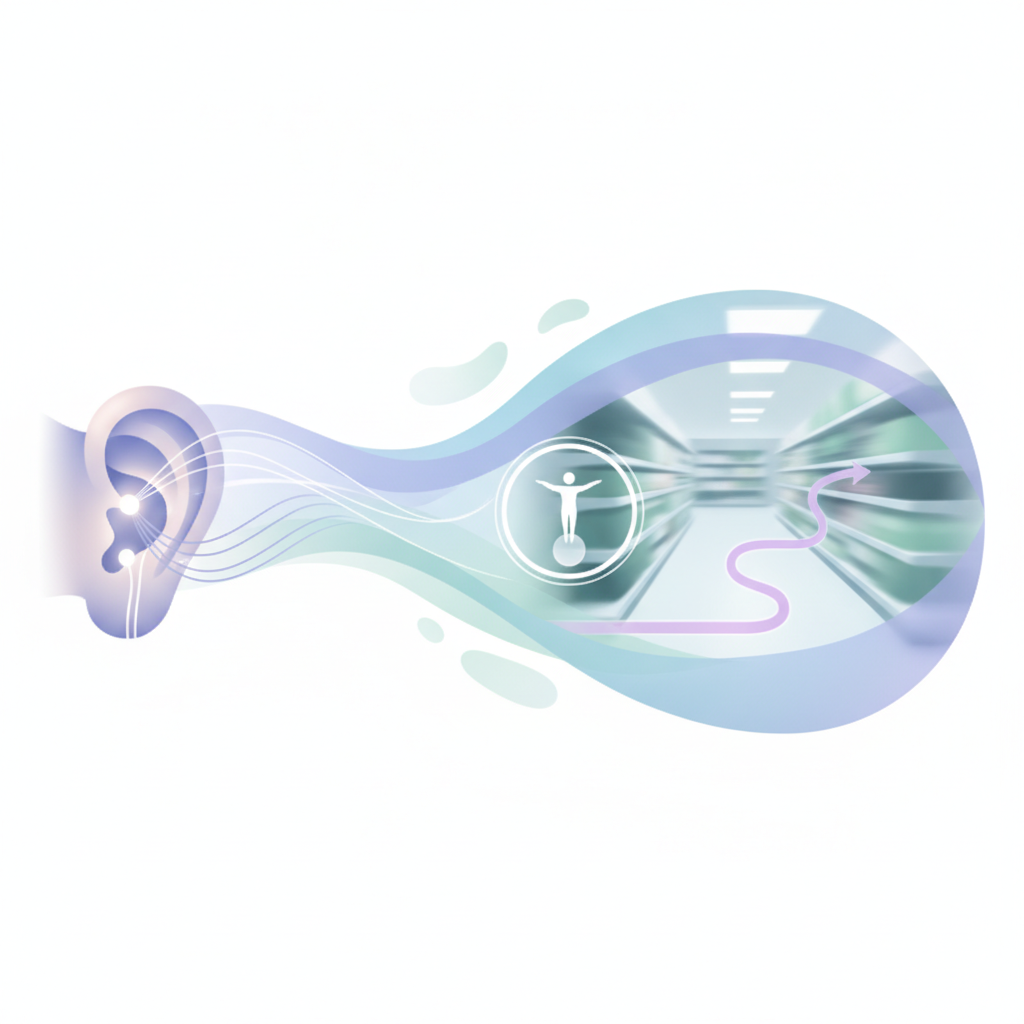
Dizziness in grocery stores is a common symptom for people recovering from concussions or living with vestibular disorders. This specific trigger occurs because the brain is forced to process overwhelming amounts of visual information—such as repeating product patterns, bright fluorescent lights, and constant motion—while simultaneously trying to maintain balance. When the vestibular system (inner ear) and the visual system (eyes) are not communicating perfectly, this sensory mismatch results in a feeling of severe off-balance, disorientation, or dizziness.
What Is Visual Vertigo?
Visual vertigo, clinically known as visually induced dizziness, is a condition where dizziness, imbalance, or spatial disorientation are triggered or significantly worsened by complex or moving visual environments.
For individuals with supermarket dizziness, the brain becomes overly reliant on visual cues to maintain balance (a phenomenon sometimes called visual dependence) because the vestibular system is injured or impaired. When faced with the overwhelming visual stimuli of busy aisle dizziness, the brain cannot filter out the background motion, resulting in symptoms like nausea, headache, and severe brain fog.
Common Triggers for Visual Vertigo
People with visual vertigo grocery store sensitivities often experience similar triggers in other environments, including:
- Walking through crowded malls or large open spaces
- Scrolling quickly on a computer screen or smartphone
- Watching fast-paced action movies
- Sitting in the back seat of a moving car
- Seeing repeating patterns, such as stripes on carpets or tiled floors
The Science Behind Supermarket Dizziness
To understand why you feel dizzy in stores, it helps to look at how the brain integrates sensory information. Your balance system relies on three primary inputs:
- Vestibular system (inner ear): Detects head movements and spatial orientation.
- Visual system (eyes): Tracks where you are in relation to objects around you.
- Proprioceptive system (nerves in feet/joints): Tells your brain what surface you are standing on.
After a concussion or during a vestibular disorder like vestibular neuritis, the inner ear signals may be inaccurate or delayed. To compensate, your brain hyper-focuses on your eyes. However, a grocery store is packed with “visual noise”—tall shelves, scrolling ceilings, and moving carts. The brain misinterprets this surrounding visual motion as actual body movement, triggering an unnecessary and exhausting survival response.
How Can Store Tolerance Be Rebuilt Safely?
Store tolerance can be rebuilt safely through a structured process called vestibular rehabilitation and gradual graded exposure. This approach retrains the brain to correctly process visual and vestibular signals without becoming overwhelmed.
Because the visual and vestibular systems are highly adaptable (a concept known as neuroplasticity), targeted exercises can effectively reduce visual vertigo over time. Rebuilding tolerance requires both at-home vestibular training and controlled, step-by-step exposure to the store environment itself.
Step 1: Build a Foundation with Gaze Stabilization
Before tackling the grocery store, it is crucial to improve your eye’s ability to stabilize on a target during head movement. This is known as Vestibular-Ocular Reflex (VOR) training.
Using a clinical app like EyeRehab - VOR Training, you can practice foundational exercises at home:
- VOR x1 and x2 exercises: Keeps targets clear while the head is moving, directly challenging the inner ear.
- Smooth Pursuits and Saccades: Improves the eyes’ ability to track objects and jump between targets smoothly, reducing eye strain.
- Optokinetic training: Accustoms the brain to moving visual fields in a controlled setting before facing the real world.
Step 2: Controlled Graded Exposure
Once you have established a baseline with gaze stabilization exercises, you can apply graded exposure to overcome dizziness in grocery stores. Graded exposure means facing the triggering environment in small, manageable doses without pushing symptoms to a severe level.
Level 1: The Drive and the Door
- Have a friend drive you to the store parking lot.
- Practice looking out the window at the moving cars and the store entrance.
- If symptoms are mild, walk up to the automatic doors, stand for 1-2 minutes, and leave.
Level 2: The Short List (Quiet Hours)
- Visit the store during off-peak hours (early morning or late evening).
- Buy just 1 to 3 items.
- Stay for a maximum of 5 to 10 minutes.
Level 3: The Cart Anchor
- Use a grocery cart. The physical contact and wide base of support from the cart provide vital proprioceptive feedback to the brain, heavily reducing busy aisle dizziness.
- Increase your time inside to 15-20 minutes.
Level 4: Full Tolerance
- Gradly increase your time, transition to carrying a basket, and eventually visit during busier hours.
Step 3: In-Store Coping Strategies
While you are rebuilding your tolerance, use these physical strategies to manage supermarket dizziness in the moment:
- Use the cart: Always push a cart, even if you are only buying a loaf of bread. It provides physical stability.
- Look near, not far: Focus your eyes directly on the items in front of you rather than looking down long, repeating aisles.
- Wear appropriate lenses: If you wear bifocals or progressive lenses, they can distort peripheral vision during walking. Consider talking to your optometrist about single-vision distance glasses for shopping.
- Take sensory breaks: If overwhelm sets in, stop the cart, close your eyes for 30 seconds, and take deep breaths to reset your nervous system.
When to Seek Professional Care
While mild symptom increases during graded exposure are normal, severe spikes are counterproductive. It is highly recommended to work with a physical therapist or vestibular specialist who can guide your recovery.
Seek immediate medical attention if you experience red flag symptoms, such as:
- Sudden, severe, “worst-ever” headache
- Double vision or sudden loss of vision
- Numbness or weakness in the face, arms, or legs
- Difficulty speaking or slurred speech
- Sudden hearing loss
- Symptoms that cause you to faint or lose consciousness
Key Takeaways
- Dizziness in grocery stores happens because of sensory mismatch—the brain relies too heavily on overwhelming visual input when the inner ear balance system is impaired.
- Visual vertigo is a treatable condition where complex visual environments trigger dizziness, nausea, and brain fog.
- Store tolerance is rebuilt safely through a combination of at-home gaze stabilization (VOR training) and graded, step-by-step exposure to the grocery store environment.
- Using a shopping cart, shopping during quiet hours, and focusing your eyes on near targets are highly effective strategies for managing symptoms during recovery.
Start your recovery journey today. The EyeRehab - VOR Training app provides targeted exercises for gaze stabilization, smooth pursuits, and balance—all designed to help your brain process visual motion without dizziness. Download EyeRehab today to take control of your vestibular health.
Disclaimer: This article is for educational purposes only and does not constitute medical advice. Always consult with a qualified healthcare provider or physical therapist before starting any new exercise program, particularly if you are recovering from a head injury or managing a vestibular disorder.
Questions fréquentes
Why do grocery stores make some people dizzy?
Use symptom patterns, safety, and day-to-day function to decide the next step. Seek urgent care for danger signs, and ask a qualified clinician for guidance when symptoms are worsening, unsafe, unusual, or not improving.
What is visual vertigo?
Use symptom patterns, safety, and day-to-day function to decide the next step. Seek urgent care for danger signs, and ask a qualified clinician for guidance when symptoms are worsening, unsafe, unusual, or not improving.
How can store tolerance be rebuilt safely?
Use symptom patterns, safety, and day-to-day function to decide the next step. Seek urgent care for danger signs, and ask a qualified clinician for guidance when symptoms are worsening, unsafe, unusual, or not improving.
Étiquettes
Écrit par
EyeRehab - VOR Training Team
Expert insights on vestibular rehabilitation and eye health.
Articles similaires
PPPD (étourdissement postural-perceptuel persistant) : symptômes, déclencheurs et rééducation
Ce qu'est le PPPD, pourquoi l'étourdissement chronique persiste après la guérison du déclencheur, et comment une rééducation vestibulaire progressive aide à retrouver la stabilité.
EyeRehab - VOR Training Team
1 juillet 2026
Exercices d'équilibre à la marche après une commotion cérébrale
Un guide d'équilibre à la marche post-commotion cérébrale qui associe la démarche, les mouvements de la tête, la charge visuelle et une progression sécurisée.
EyeRehab - VOR Training Team
25 juin 2026

Exercices d'équilibre les yeux fermés : sécurité et progression
Expliquez comment les exercices d'équilibre les yeux fermés modifient la demande sensorielle et comment les faire évoluer en toute sécurité.
EyeRehab - VOR Training Team
20 juin 2026