Exercices d'équilibre à la marche après une commotion cérébrale
Un guide d'équilibre à la marche post-commotion cérébrale qui associe la démarche, les mouvements de la tête, la charge visuelle et une progression sécurisée.
EyeRehab - VOR Training Team
Publié le 25 juin 2026
Écouter cet article
Narration Kokoro-MLX · 7 min
Réponse courte
Why can walking feel unsteady after concussion?
A post-concussion walking balance guide that links gait, head movement, visual load, and safe progression.
Révisé le 25 juin 2026
Understanding Walking Balance Exercises After Concussion
Returning to steady movement after a head injury takes time, patience, and the right rehabilitation strategy. Incorporating structured walking balance exercises after concussion is essential to safely retrain the brain, reduce dizziness, and prevent secondary injuries from falls. Whether you are an athlete returning to play or an individual managing daily vestibular dysfunction, a gradual, step-by-step approach to balance training is crucial for a safe recovery.
Why You May Experience Unsteady Walking After Concussion
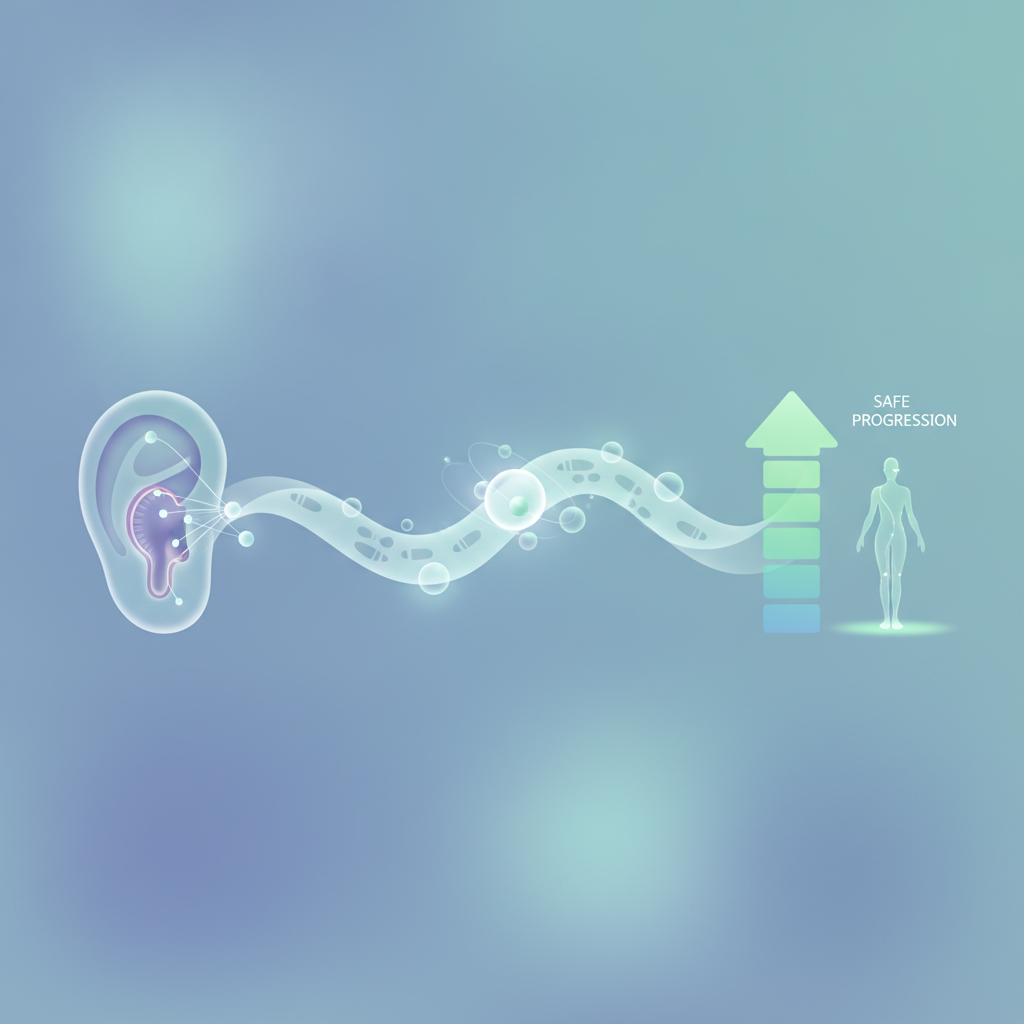
Unsteady walking after concussion occurs because a head injury frequently disrupts the complex communication between your brain, your inner ear (vestibular system), and your visual system. Your brain relies on these three systems working perfectly together to maintain spatial awareness and postural control.
When a concussion damages or temporarily impairs the vestibular-ocular reflex (VOR) or visual tracking abilities, the brain struggles to process sensory input accurately. This sensory mismatch often results in balance problems after concussion, leading to common symptoms such as dizziness, vertigo, delayed reaction times, and a feeling of being pulled to one side while walking.
Effective Walking Balance Exercises After Concussion
Practicing targeted gait exercises after concussion helps restore neuromuscular coordination and visual stability. The following exercises should be performed in a safe environment, such as a hallway with a wall nearby for support. Stop any exercise if your symptoms spike significantly, and aim to keep your symptom elevation during these activities to a manageable level.
1. Tandem Gait (Heel-to-Toe Walking)
Tandem gait challenges your dynamic balance by narrowing your base of support, forcing your brain and muscles to make rapid postural corrections.
- Setup: Stand at one end of a hallway. Focus your eyes on a stationary target straight ahead.
- Steps:
- Place your right foot directly in front of your left foot, so the heel of your front foot is touching the toes of your back foot.
- Shift your weight to the front foot.
- Step forward with your back foot, placing it heel-to-toe in front of the other.
- Continue for 10 to 15 steps.
- Progressions: Once you master this on a flat surface with eyes open, try walking backward in the same heel-to-toe pattern, or try the exercise while slowly turning your head left and right (vestibular walking exercises).
- Common Mistakes: Looking down at your feet instead of keeping your gaze stabilized on the horizon. Rushing the steps before establishing a stable rhythm.
- Tips: Use the smooth pursuit and gaze stabilization techniques you practice during VOR training to keep your eyes locked on a target while your body moves.
2. Walking with Head Turns (Gaze Stabilization Walking)
This exercise directly trains the vestibular system to maintain clear vision and balance while the head is in motion.
- Setup: Walk in a straight line at a normal, comfortable pace.
- Steps:
- Begin walking forward.
- Once you have a steady rhythm, smoothly turn your head to the left, and then smoothly turn your head to the right, timing the turns with your strides.
- Keep your eyes focused forward on your path even as your head turns.
- Progressions: Perform vertical head turns (looking up at the ceiling, then down at the floor) while walking. Increase your walking speed as tolerated.
- Common Mistakes: Moving the head too quickly or erratically, which can trigger acute dizziness or nausea.
- Tips: If double vision or severe dizziness occurs, slow down your walking pace and reduce the range of motion of your head turns.
3. Figure-of-Eight Walking
This drill improves your ability to handle directional changes and shift your weight dynamically, which is essential for sports and navigating crowded environments.
- Setup: Place two objects (like water bottles or cones) on the floor about 5 to 6 feet apart.
- Steps:
- Begin walking in a wide figure-of-eight pattern around the objects.
- Keep your pace smooth and continuous without stopping to pivot.
- Complete 5 loops in one direction, then reverse the pattern.
- Progressions: Gradually move the objects closer together to tighten the turns and further challenge your balance.
- Common Mistakes: Stopping your momentum completely before changing directions. Staring down at the objects.
- Tips: Keep your core engaged. If you feel off-balance, widen your stepping stance to create a more stable base.
How Should Walking Balance Drills Progress?
Walking balance drills should progress by systematically increasing sensory, motor, and cognitive demands as your brain adapts and your symptoms improve. Recovery is not a linear process, so progression must always be guided by symptom tolerance and clinical guidance.
A standard progression follows these four stages:
- Static to Dynamic: Master standing balance on two feet and one leg before transitioning to forward walking.
- Simple to Complex Gait: Begin with straight-line walking, then advance to tandem (heel-to-toe) walking, backward walking, and eventually lateral shuffling or figure-of-eights.
- Adding Sensory Challenges: Diminish your sensory input to force your brain to work harder. This includes walking in dimly lit rooms, walking on softer surfaces (like grass or carpet), or walking while wearing a pair of sunglasses to reduce visual reliance.
- Dual-Tasking: The final stage of vestibular walking exercises involves cognitive or motor dual-tasking. This means walking your balance drill while counting backward by 7s, reciting the alphabet, or lightly tossing a ball to a partner. Dual-tasking prepares your brain for the complex, unpredictable demands of daily life and sports.
Key Takeaways
- Sensory Disruption: Unsteady walking after concussion is a common symptom caused by miscommunication between the brain, visual, and vestibular systems.
- Targeted Rehabilitation: Specific gait exercises after concussion, like tandem walking and walking with head turns, are highly effective for retraining balance and gaze stability.
- Safe Progression: Progress your walking balance exercises after concussion gradually by adding head movements, changing visual inputs, altering surfaces, and incorporating cognitive dual-tasks.
- Monitor Symptoms: Track symptoms like brain fog, dizziness, and nausea during and after exercises. Recovery requires pushing boundaries slightly, but never to the point of severe symptom flare-ups.
Start Your Recovery with EyeRehab
Navigating a concussion or vestibular disorder recovery protocol is much easier with the right clinical tools in your pocket. The EyeRehab - VOR Training app provides guided vestibular walking exercises, VOR x1 and x2 training, Cawthorne-Cooksey protocols, and comprehensive balance drills. With built-in symptom tracking and automated difficulty progressions, you can safely manage your recovery journey. Download the EyeRehab app today to take control of your vestibular health.
Medical Disclaimer
This blog post is for informational and educational purposes only and does not constitute medical advice. It is not a substitute for professional medical diagnosis, treatment, or specialized care. Always consult with a qualified healthcare provider, physical therapist, or vestibular specialist before beginning any new exercise program after a head injury. If you experience severe dizziness, sudden changes in vision, or a loss of consciousness, seek medical attention immediately.
Questions fréquentes
Why can walking feel unsteady after concussion?
Use symptom patterns, safety, and day-to-day function to decide the next step. Seek urgent care for danger signs, and ask a qualified clinician for guidance when symptoms are worsening, unsafe, unusual, or not improving.
Which walking balance exercises help after concussion?
Use symptom patterns, safety, and day-to-day function to decide the next step. Seek urgent care for danger signs, and ask a qualified clinician for guidance when symptoms are worsening, unsafe, unusual, or not improving.
How should walking balance drills progress?
Use symptom patterns, safety, and day-to-day function to decide the next step. Seek urgent care for danger signs, and ask a qualified clinician for guidance when symptoms are worsening, unsafe, unusual, or not improving.
Étiquettes
Écrit par
EyeRehab - VOR Training Team
Expert insights on vestibular rehabilitation and eye health.
Articles similaires
PPPD (étourdissement postural-perceptuel persistant) : symptômes, déclencheurs et rééducation
Ce qu'est le PPPD, pourquoi l'étourdissement chronique persiste après la guérison du déclencheur, et comment une rééducation vestibulaire progressive aide à retrouver la stabilité.
EyeRehab - VOR Training Team
1 juillet 2026
Exercices d'équilibre les yeux fermés : sécurité et progression
Expliquez comment les exercices d'équilibre les yeux fermés modifient la demande sensorielle et comment les faire évoluer en toute sécurité.
EyeRehab - VOR Training Team
20 juin 2026
Exercices optocinétiques pour les vertiges : ce qu'il faut savoir
Expliquer les exercices optocinétiques pour les vertiges, qui peut en bénéficier, et pourquoi un dosage progressif est important en cas de sensibilité visuelle au mouvement.
EyeRehab - VOR Training Team
20 juin 2026