Exercices d'équilibre les yeux fermés : sécurité et progression
Expliquez comment les exercices d'équilibre les yeux fermés modifient la demande sensorielle et comment les faire évoluer en toute sécurité.
EyeRehab - VOR Training Team
Publié le 20 juin 2026
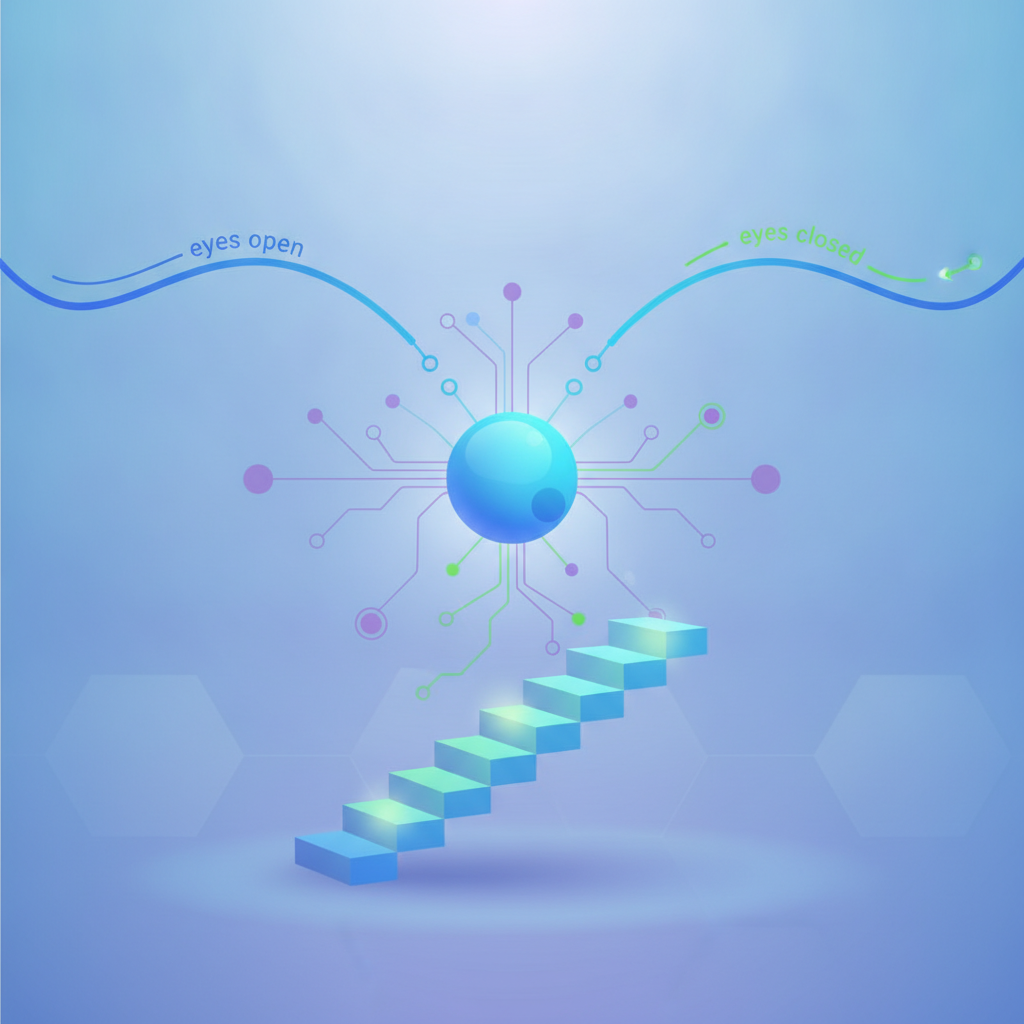
Écouter cet article
Narration Kokoro-MLX · 7 min
Réponse courte
Why are balance exercises harder with eyes closed?
Explain how eyes-closed balance exercises change sensory demand and how to progress them safely.
Révisé le 20 juin 2026
Why Balance Exercises Eyes Closed Are Essential for Vestibular Recovery
Rebuilding stability after a concussion or vestibular disorder requires a progressive approach to sensory input. Incorporating balance exercises eyes closed into your routine intentionally removes visual cues, forcing your brain to rely on internal signals to stay upright. While highly effective for recovery, this training requires careful execution, strict safety measures, and a structured plan to ensure success.
Why Are Balance Exercises Harder With Eyes Closed?
Closing your eyes during vestibular balance exercises makes the task significantly harder because it removes visual feedback, which is the brain’s primary and fastest sensory input for balance.
The human body relies on a sensory “tripod” to maintain balance:
- Vision (Visual system): Tells the brain where the body is in relation to the environment.
- Proprioception (Somatosensory system): Sensors in the muscles and joints tell the brain where body parts are positioned (e.g., feeling the floor).
- Inner Ear (Vestibular system): Detects head movements and gravity.
When you close your eyes, you eliminate 33% of your brain’s immediate balancing data. If your vestibular system is impaired due to a concussion, vestibular neuritis, or BPPV, your brain suddenly has to rely on a damaged system while missing its primary visual crutch. This sensory mismatch forces the brain to work harder, which temporarily spikes dizziness, brain fog, and postural sway until the system adapts.
When Is Eyes-Closed Balance Training Appropriate?
Eyes-closed balance training is appropriate only after you can safely and comfortably perform the exact same balance exercises with your eyes open without severe symptom exacerbation.
According to vestibular rehabilitation clinical practice guidelines, balance training must be progressive. Introducing standing balance eyes closed too early in a concussion recovery protocol can easily overwhelm the central nervous system, causing a significant spike in dizziness or nausea that sets back your recovery.
This intervention is most appropriate when:
- You have mastered eyes-open standing balance on a firm surface.
- You are working with a physical therapist to challenge your vestibular system.
- You are an athlete returning to sport, requiring enhanced proprioceptive awareness.
- You are an older adult looking to build fall-proof stability in case of low-light situations.
What Safety Setup Is Needed for Eyes-Closed Balance Training?
The required safety setup for balance exercises eyes closed involves a clear physical environment and physical support structures to prevent falls. Because removing vision significantly increases the risk of losing balance, you must engineer a safe environment before closing your eyes.
To ensure safety:
- Use a Corner: Stand in the corner of a room. If you lose your balance backward, the walls will catch you. If you fall forward, you can easily step out of the stance.
- Provide Hand Support: Place a sturdy, heavy chair or a waist-high table directly in front of you. Keep your hands hovering just an inch above the surface so you can grab it instantly if you sway too far.
- Clear the Floor: Ensure the ground is completely free of rugs, cords, pets, or clutter.
- Have Supervision: If you have severe deficits, experience significant dizziness, or are an older adult with fall risks, a caregiver or healthcare professional must stand directly beside you for hands-on guarding.
Step-by-Step Tutorial: Standing Balance Eyes Closed
The most foundational eyes closed balance training exercise is the Romberg stance. This exercise trains the brain to trust the vestibular system without visual input.
Setup
- Position yourself in the corner of a room.
- Place a sturdy chair an arm’s length in front of you.
- Wear flat, supportive, non-slip shoes (unless specifically advised by a PT to go barefoot for sensory input).
Execution Steps
- Stand with your feet shoulder-width apart.
- Hover your hands over the chair or lightly touch it with one fingertip (try to rely on touch as little as possible).
- Slowly close your eyes.
- Keep your body completely still. Focus your mental attention on the sensation of your feet pressing into the floor (proprioception).
- Hold this position for 30 to 60 seconds.
- Open your eyes, wait for any dizziness to settle, and rest.
How to Safely Progress Balance Exercises Eyes Closed
Once you can hold the standard stance for 60 seconds without severe dizziness or needing to grab the chair, you must progressively challenge the sensory and motor systems to continue making neurological gains.
Progression 1: Narrow the Base of Support
- Move your feet together so they are touching (Modified Romberg).
- Progress to a semi-tandem stance (instep of one foot touching the big toe of the other).
- Progress to a full tandem stance (heel-to-toe, as if standing on a tightrope).
Progression 2: Alter the Surface (Somatosensory Challenge)
- Move from a hard floor to a medium-density foam pad, sofa cushion, or folded towel. This disrupts proprioception, forcing your vestibular system to work even harder.
Progression 3: Dynamic Movement (Cawthorne-Cooksey Principles)
- While in your balance stance with eyes closed, slowly turn your head to the left and right. This directly challenges the vestibular-ocular reflex (VOR) and mimics real-world walking dynamics.
Common Mistakes to Avoid
- Pushing Through High Symptoms: A mild, tolerable increase in dizziness (about a 2-3 out of 10) is normal. If your dizziness spikes, you feel nauseous, or your brain fog becomes severe, open your eyes and stop. Pushing past your symptom threshold delays nervous system recovery.
- Holding Your Breath: Subconsciously holding your breath tightens the body and restricts normal postural sway. Breathe deeply and rhythmically throughout the exercise.
- Using Too Much Hand Support: White-knuckling the chair gives your brain false stability. Aim to hover your hands or use a single, light fingertip to promote true vestibular adaptation.
Tracking Symptoms During Vestibular Balance Exercises
Symptom monitoring is a cornerstone of concussion and vestibular rehabilitation. Because balance exercises for dizziness intentionally trigger mild symptom provocation, tracking your metrics helps you find the “sweet spot” of effort without overexertion.
Before you begin a balance session, rate your dizziness, headache, and brain fog on a scale of 0 to 10. After a 60-second hold, rate them again. If your symptoms increase by more than 2 or 3 points, or if they take longer than 15-20 minutes to return to baseline, you should regress the exercise (e.g., open your eyes, widen your stance, or take a break for the day).
Key Takeaways
- Balance exercises eyes closed are highly effective because they force the brain to rely on the vestibular system and proprioception by removing visual input.
- Safety is paramount: Always perform these exercises in a corner with a sturdy chair nearby, and use a spotter if you have a high fall risk.
- Progression is required: Start with feet shoulder-width apart. If symptoms remain stable, progress to tandem stances, foam surfaces, and dynamic head turns.
- Monitor symptoms closely: Mild dizziness is normal during training, but severe spikes in dizziness or nausea mean you should reduce the difficulty.
Start Your Recovery with EyeRehab - VOR Training
Mastering vestibular balance exercises requires structured progression and daily symptom tracking. The EyeRehab - VOR Training app provides customized protocols for VOR x1/x2 training, saccades, smooth pursuits, and balance training. With built-in symptom tracking for dizziness, brain fog, and eye strain, you can safely progress your recovery at the right pace. Download EyeRehab today to take control of your vestibular health.
Disclaimer: This blog post is for educational purposes only and does not constitute medical advice. Always consult with a qualified healthcare professional, physical therapist, or vestibular specialist before beginning any new exercise program, especially if you are recovering from a head injury or managing a vestibular disorder.
Questions fréquentes
Why are balance exercises harder with eyes closed?
Use symptom patterns, safety, and day-to-day function to decide the next step. Seek urgent care for danger signs, and ask a qualified clinician for guidance when symptoms are worsening, unsafe, unusual, or not improving.
When is eyes-closed balance training appropriate?
Use symptom patterns, safety, and day-to-day function to decide the next step. Seek urgent care for danger signs, and ask a qualified clinician for guidance when symptoms are worsening, unsafe, unusual, or not improving.
What safety setup is needed?
Use symptom patterns, safety, and day-to-day function to decide the next step. Seek urgent care for danger signs, and ask a qualified clinician for guidance when symptoms are worsening, unsafe, unusual, or not improving.
Étiquettes
Écrit par
EyeRehab - VOR Training Team
Expert insights on vestibular rehabilitation and eye health.
Articles similaires
PPPD (étourdissement postural-perceptuel persistant) : symptômes, déclencheurs et rééducation
Ce qu'est le PPPD, pourquoi l'étourdissement chronique persiste après la guérison du déclencheur, et comment une rééducation vestibulaire progressive aide à retrouver la stabilité.
EyeRehab - VOR Training Team
1 juillet 2026
Exercices d'équilibre à la marche après une commotion cérébrale
Un guide d'équilibre à la marche post-commotion cérébrale qui associe la démarche, les mouvements de la tête, la charge visuelle et une progression sécurisée.
EyeRehab - VOR Training Team
25 juin 2026
Exercices optocinétiques pour les vertiges : ce qu'il faut savoir
Expliquer les exercices optocinétiques pour les vertiges, qui peut en bénéficier, et pourquoi un dosage progressif est important en cas de sensibilité visuelle au mouvement.
EyeRehab - VOR Training Team
20 juin 2026