Visual Vertigo: Why Busy Places Make You Dizzy
Why supermarkets, traffic and crowds can provoke visual vertigo, what graded rehabilitation involves, and when to seek assessment for your symptoms.
Ilyas Bakouch, Founder of EyeRehab
Published on June 15, 2026 · Updated on October 7, 2026
Listen to this article
Natural Language Narration · 7 min
Quick answer
Why do supermarkets and busy places make me dizzy?
Moving or complex scenes can provoke visually induced dizziness. This pattern may occur with several vestibular or related conditions and does not identify one diagnosis. Assessment can determine whether graded visual-motion work or another treatment fits.
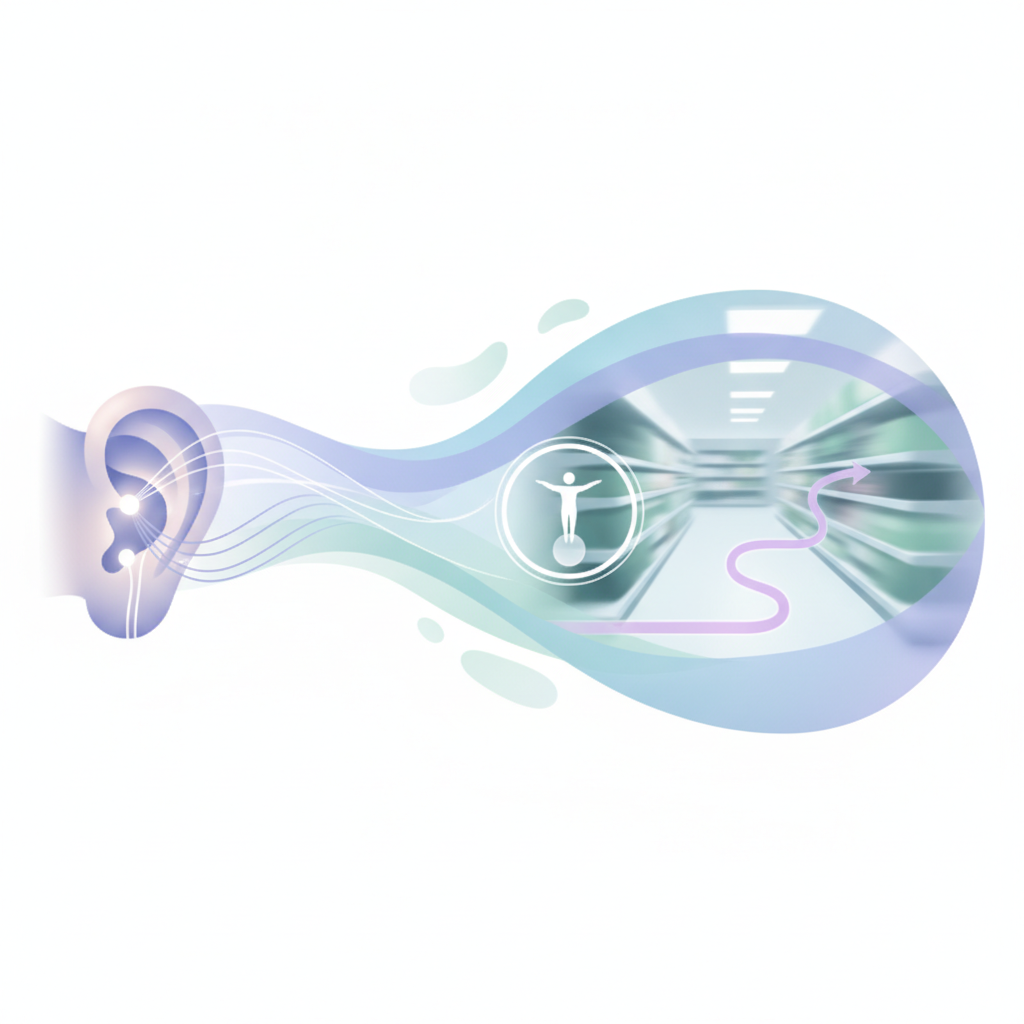
You can feel reasonably steady at home, then walk into a supermarket and become dizzy, nauseated, or disoriented. Shelves extend into the distance. People cross your path. Your eyes move between labels while your head turns and your body keeps walking.
That pattern is often called visual vertigo or visually induced dizziness. It describes symptoms brought on by moving or complex visual surroundings. It is a useful description, but it is not a diagnosis of the underlying cause.
Medical information: This article is educational and does not replace professional diagnosis. New, persistent, worsening, or function-limiting dizziness deserves assessment. A qualified clinician can decide whether rehabilitation or another treatment is appropriate.
Why supermarkets can be difficult
Balance depends on the brain combining visual, inner-ear, and body signals. A busy store adds movement and visual detail while you are also navigating, reaching, and looking around. For someone sensitive to visual motion, that combination can be harder to tolerate than a quiet room.
People sometimes describe a floating sensation, feeling pulled toward the shelves, difficulty focusing, or a need to leave the aisle. Others notice nausea or a headache. These experiences can occur in several conditions, including vestibular disorders, vestibular migraine, concussion-related symptoms, and persistent postural-perceptual dizziness (PPPD).
Read how vision and balance work together for the sensory-system explanation. A trigger such as a supermarket does not tell you which condition is responsible.
Visual dependence and sensory mismatch
Visual dependence means relying heavily on what you see to orient yourself. When the visual scene moves or becomes difficult to interpret, that reliance may contribute to symptoms.
Sensory mismatch is a related idea: visual motion can suggest movement that does not match the signals from your head and body. Watching traffic from a stationary position is one example. Scrolling is another; the image moves while you may be sitting still.
These mechanisms are useful explanations, not proof that your inner ear is damaged or your eyes are unhealthy. The symptom pattern still needs to be interpreted in context.
Common triggers
| Setting | What may add to the challenge |
|---|---|
| Supermarket aisles | Repeated patterns, scanning shelves, other shoppers |
| Crowds or shopping centres | Movement in several directions while walking |
| Traffic | Large objects passing across the visual field |
| Scrolling or fast video | Moving images while the head is relatively still |
| Patterned floors or displays | Dense visual detail and competing orientation cues |
Your triggers may differ. The goal is to identify the situations that matter to your life, rather than label every busy environment as something to avoid.
If a phone is the main problem, the scrolling-and-dizziness guide describes practical adjustments and when to seek assessment.
Visual vertigo is not automatically PPPD
PPPD is a defined disorder. The Bárány Society diagnostic criteria describe dizziness, unsteadiness, or non-spinning vertigo present on most days for at least three months, with characteristic aggravation by upright posture, movement, and complex or moving visual stimuli. Other criteria must also be met.
Having symptoms in a store does not meet those criteria on its own. PPPD can also coexist with vestibular or other conditions. A clinician should consider the whole history rather than choose a diagnosis from a single trigger.
Anxiety may accompany dizziness, particularly when an outing feels unpredictable. That does not make the symptoms imaginary. Tell your clinician about both the physical symptoms and the worry or avoidance they create; both can affect the care plan.
What can help during an outing?
Practical adjustments can make a necessary trip more manageable while you arrange care:
- Choose a quieter time and a shorter shopping list.
- Take breaks in a calm area before you become unsafe or overwhelmed.
- Ask someone to accompany you if imbalance affects your safety.
- Pause walking when you need to examine a label instead of combining several tasks.
- Leave the situation if symptoms make it unsafe to continue. Do not drive while dizzy or disoriented.
These are ways to reduce the immediate demand. They are not a treatment protocol or a guarantee that a particular store visit will be symptom-free.
How rehabilitation approaches visual motion
Clinician-directed rehabilitation may include gradual exposure to selected movements or visual scenes, together with other exercises indicated by the assessment. The aim is to build useful tolerance without an excessive symptom response.
A randomized trial of optokinetic exercise in peripheral vestibular disorders studied moving visual stimuli within a customized vestibular program. It supports considering structured visual-motion work for an appropriate patient, not copying a fast-moving online video as a universal cure.
Optokinetic stimulation means viewing a moving visual pattern. Ordinary phone use can also expose you to visual motion, but uncontrolled scrolling is not equivalent to a prescribed rehabilitation exercise. Challenge, duration, recovery, and supervision matter.
Ask your clinician what response is acceptable, when to pause, and how progression will be decided. Avoid forcing a long exposure because symptoms must supposedly get worse before they improve. An exercise that repeatedly disrupts the rest of your day needs review.
What to record before an appointment
Note the trigger, whether you were walking or still, how long symptoms lasted, and whether there was spinning, headache, double vision, hearing change, or a near-fall. Record whether the same thing happens outside stores and when the pattern began.
An eye examination may help if near work, double vision, or focusing difficulty is prominent. A vestibular assessment may be appropriate when movement, imbalance, or head turns are important triggers. Primary care can help coordinate assessment when several possibilities overlap. The eyes-or-inner-ear guide compares those patterns without treating them as diagnostic rules.
Seek urgent medical care for sudden dizziness with new weakness, speech difficulty, persistent double vision, severe unusual headache, fainting, or inability to stand or walk safely. Sudden hearing loss also needs urgent assessment.
A useful next step is an explanation that fits your symptoms and a plan you can carry into daily life. “Spend more time in busy places” is not specific enough on its own.
Frequently Asked Questions
Does supermarket dizziness mean PPPD?
No. PPPD has several diagnostic criteria, including persistent symptoms on most days for at least three months. A store trigger alone is insufficient.
Should I force myself to stay in a busy store?
Do not continue if you are unsafe or overwhelmed. A clinician-directed exposure plan should specify challenge, duration, symptom limits and progression.
Is ordinary scrolling a desensitization exercise?
Not automatically. Recreational scrolling has uncontrolled visual demands and is not equivalent to a prescribed visual-motion task.
Tags
Written by
Ilyas Bakouch, Founder of EyeRehab
Building EyeRehab to make vestibular home practice easier to follow and clinical care easier to connect.
Related Articles
The Epley Maneuver in Clinic: A Practical BPPV Repositioning Workflow for Clinicians
An evidence-informed workflow for the Epley maneuver in posterior canal BPPV: assessment, technique, intra-procedure nystagmus monitoring, follow-up decisions, and home-instruction considerations.
Eye Rehab Editorial Team
October 29, 2026

Visual Motion Sensitivity Exercises for Dizziness
Explain visual motion sensitivity and how graded visual exposure and optokinetic-style exercises can fit into vestibular rehab.
EyeRehab - VOR Training Team
October 23, 2026
Blurry Vision and Dizziness: Causes and Next Steps
Understand blurry vision with dizziness, which symptom patterns need assessment, and when guided vestibular exercises may fit your care plan.
EyeRehab Editorial Team
October 7, 2026