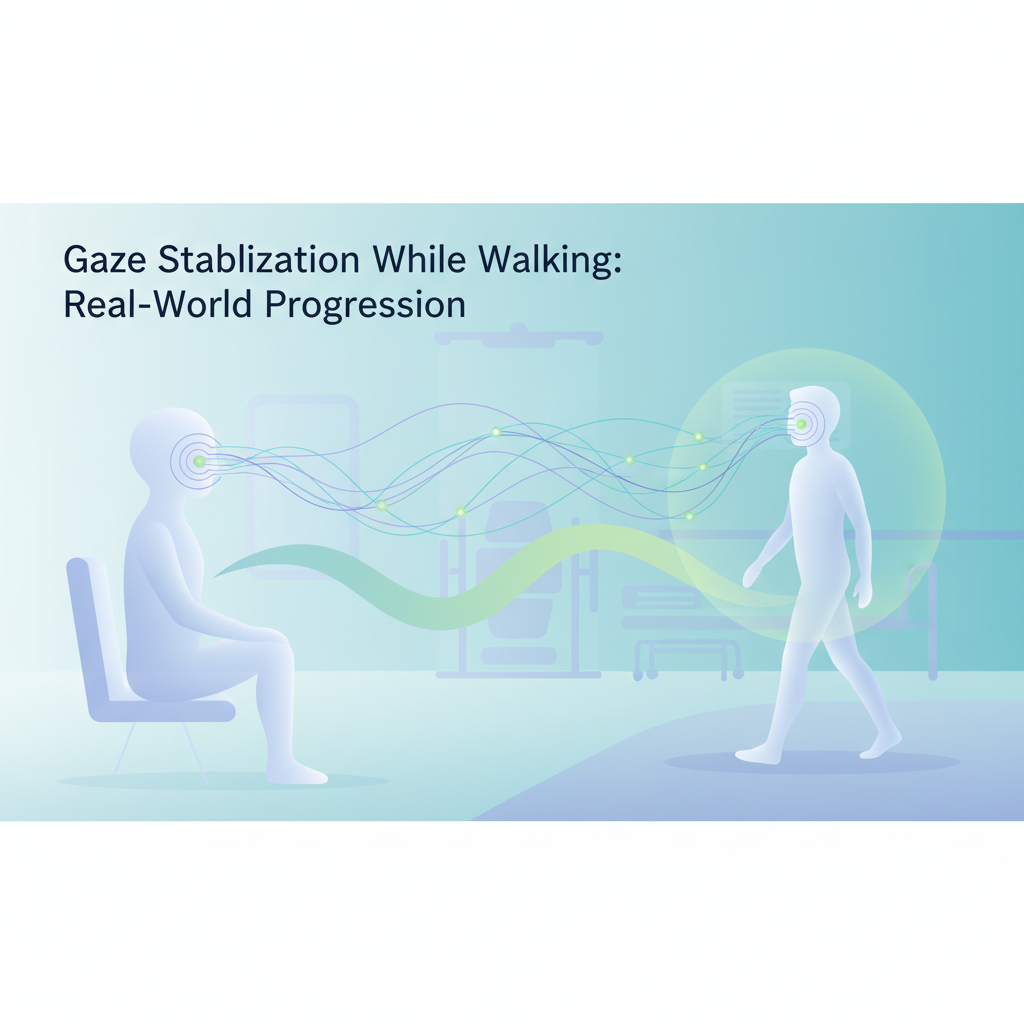
Gaze Stabilization While Walking: Real-World Progression
Show how gaze stabilization can progress from seated drills to walking tasks without losing symptom control or safety.
EyeRehab - VOR Training Team
Published on June 9, 2026
Listen to this article
Natural Language Narration · 7 min
Quick answer
How do gaze stabilization exercises progress into walking?
Show how gaze stabilization can progress from seated drills to walking tasks without losing symptom control or safety.
Reviewed on June 9, 2026
Returning to Real-World Movement
Recovering from a concussion or vestibular disorder requires moving beyond seated exercises and returning to functional movement. Mastering gaze stabilization while walking is a critical milestone that bridges the gap between clinical exercises and real-world activities, helping you navigate your environment with confidence.
Why can walking make gaze exercises harder?
Walking makes gaze exercises harder because it forces the brain to simultaneously process balance, spatial orientation, and vision. When you are seated, your body is physically supported, allowing your brain to focus entirely on keeping your vision stable during head movements. Once you start walking, your vestibular system must actively maintain your upright balance against gravity while also coordinating the vestibulo-ocular reflex (VOR). This dual demand significantly increases the cognitive and neurological load, which is why gaze stability walking dizziness is a common and frustrating symptom for many patients.
What safety setup is needed for walking gaze drills?
A safe setup for walking gaze drills requires a clear, unobstructed hallway or open space with even flooring and good lighting. Because these exercises challenge your balance and can provoke dizziness, safety must be your primary focus before you begin moving.
To ensure a safe environment:
- Use a wall or hallway: Position yourself next to a wall or walk in a narrow hallway so you can easily reach out and touch the wall for support if you lose balance.
- Clear the floor: Remove all rugs, cords, pet toys, and other tripping hazards from your path.
- Have a chair nearby: Keep a sturdy chair at either end of your walking path so you can immediately sit down if your symptoms spike.
- Wear proper footwear: Wear flat, supportive, closed-toe shoes with good traction.
- Enlist a spotter: If you are highly symptomatic or recovering from a severe concussion, have a family member or caregiver walk beside you for physical support.
How do gaze stabilization exercises progress into walking?
Gaze stabilization exercises progress into walking by systematically adding movement complexity only when foundational exercises are tolerated without severe symptom spikes. Clinical vestibular rehabilitation relies on a structured step-by-step approach to ensure the brain adapts safely.
You should progress through these phases gradually:
- Static Seated: Performing VOR exercises (like looking at a target while turning your head) while sitting down.
- Static Standing: Performing the exact same head and eye movements while standing still on a firm surface.
- Dynamic Standing: Shifting your weight from foot to foot or marching in place while maintaining a stable gaze.
- Straight-Line Walking: Walking forward in a straight line while keeping your gaze fixed straight ahead.
- Walking with Head Turns: Adding horizontal and eventually vertical head movements while walking.
You are ready to progress to the next step when you can perform the current level for several minutes without a significant increase in dizziness, brain fog, or nausea.
Gaze Stabilization While Walking: Step-by-Step Tutorial
This tutorial focuses on VOR x1 exercises integrated with ambulation. It is designed to train your brain to keep your eyes focused on a target while your body is in motion.
Setup
- Find a clear, straight pathway in your home, ideally a long hallway.
- Pick a fixed target on the wall directly in front of you at eye level (such as a piece of tape, a clock, or a doorknob).
Step 1: Straight-Line Walking (Baseline)
- Stand at one end of the hallway and fix your eyes on your target.
- Begin walking slowly toward the target while keeping your head entirely still.
- Focus solely on keeping the target clear and in sharp focus while your body moves through space.
- Walk for 10 to 20 feet, then rest.
Step 2: Horizontal Head Turns (VOR x1 Walking)
- Begin walking slowly down the hallway.
- Once you establish a steady pace, start turning your head left and right in time with your steps.
- The Rule: Look at the wall to your left as your left foot strikes the floor, and look at the wall to your right as your right foot strikes the floor.
- Ensure your eyes lead the way—look at the wall, then let your head follow.
- Maintain a soft, distant gaze rather than staring intensely at one specific object.
Step 3: Vertical Head Turns (VOR x1 Walking)
- Begin walking slowly.
- Smoothly nod your head up and down as you walk.
- Look up at the ceiling for two steps, then look down at the floor in front of you for two steps.
- Ensure the visual field remains stable and does not bounce excessively.
Step 4: Advanced Progressions (VOR x2 and Optokinetic)
- VOR x2: Once horizontal and vertical turns feel easy, try moving your head and eyes in opposite directions simultaneously while walking.
- Complex Environments: Transition your vestibular walking exercises outdoors or in a busy visual environment, like a grocery store aisle, to challenge your brain with dynamic visual input.
Common Mistakes to Avoid
- Moving too quickly: Walking at a normal or fast pace too early will overwhelm your vestibular system. Start at a deliberate, slow pace.
- Holding your breath: Breath-holding spikes anxiety and alters blood pressure. Focus on exhaling as you step and turn your head.
- Looking at your feet: Fixating on the ground right in front of you disrupts natural visual-vestibular integration. Keep your gaze lifted and look straight ahead.
- Pushing through severe symptoms: A slight, temporary increase in symptoms is normal, but a severe spike in headache, intense vertigo, or vomiting means you need to stop and regress to an easier exercise.
Key Takeaways
- Walking adds a balance demand to your vision exercises, making gaze stabilization significantly more challenging but highly effective.
- Always set up a safe environment with clear floors and walls to lean on before attempting dynamic vestibular exercises.
- Progress logically: master seated exercises, then standing, then straight walking, and finally walking with head turns.
- Use structured symptom tracking to monitor your progress and identify exactly which vestibular walking exercises trigger your dizziness.
Continue Your Recovery with EyeRehab - VOR Training
Ready to safely advance your rehabilitation? The EyeRehab - VOR Training app provides guided, progressive exercises for vestibular and concussion recovery right from your phone. With built-in symptom tracking and difficulty progressions for VOR, saccades, smooth pursuit, and balance training, you can confidently guide your real-world recovery. Download the app today to take control of your vestibular health.
Medical Disclaimer
This content is for informational and educational purposes only and does not constitute medical advice. Vestibular rehabilitation exercises can provoke significant symptoms; always consult with a qualified healthcare professional, such as a physical therapist or vestibular specialist, before beginning any new exercise regimen, especially following a head injury or concussion. Stop immediately if you experience severe pain, extreme dizziness, or a sudden decline in your condition.
Frequently Asked Questions
How do gaze stabilization exercises progress into walking?
Use symptom patterns, safety, and day-to-day function to decide the next step. Seek urgent care for danger signs, and ask a qualified clinician for guidance when symptoms are worsening, unsafe, unusual, or not improving.
Why can walking make gaze exercises harder?
Use symptom patterns, safety, and day-to-day function to decide the next step. Seek urgent care for danger signs, and ask a qualified clinician for guidance when symptoms are worsening, unsafe, unusual, or not improving.
What safety setup is needed for walking gaze drills?
Use symptom patterns, safety, and day-to-day function to decide the next step. Seek urgent care for danger signs, and ask a qualified clinician for guidance when symptoms are worsening, unsafe, unusual, or not improving.
Tags
Written by
EyeRehab - VOR Training Team
Expert insights on vestibular rehabilitation and eye health.
Related Articles
VOR Exercises for Blurry Vision With Head Movement
Connect VOR exercises to blurry vision during head movement and explain safe progression for gaze stability.
EyeRehab - VOR Training Team
September 11, 2026
Keep Your Eyes on the Target: Hands-Free Pace Audio for VOR Training
Eye Rehab 5.07.101 adds Off, Ticks, and Tones for VOR x1 and VOR x2, plus a sustained correction cue when head tracking detects persistent pace drift.
Ilyas Bakouch, Founder of Eye Rehab
September 10, 2026
VOR X2 Exercises: When to Progress Beyond VOR X1
A practical guide to VOR x2 exercises, including when they are appropriate, how they differ from VOR x1, and how to pace progression.
EyeRehab - VOR Training Team
September 1, 2026